Countdown timer statistics, with the source for each
By Danish Mohammed, founder. 5 min read
The number people usually want from a page like this is a conversion lift. There is none below. I could not trace a lift figure for email countdown timers to a test with a date and a published method. A figure goes on this page with a dated primary source or not at all.
What is left says where a timer will be opened and how often the timers on shopping sites turn out to be fake. It ends with one controlled experiment on urgency. Every source was read on 17 September 2026.
Where a countdown timer gets opened
Litmus publishes a monthly share of email opens by client. Its July 2026 report was “Calculated from over 1 billion opens in Litmus Email Analytics, in July 2026”. So it describes the opens Litmus’s own analytics measured, not all email everywhere. The table gives the first six of its top ten.
| Client, as Litmus groups it | Share of opens, July 2026 |
|---|---|
| Apple | 62.26% |
| Gmail | 27.03% |
| Outlook (desktop) | 5.83% |
| Yahoo Mail | 2.59% |
| Google Android | 1.45% |
| Outlook.com | 0.42% |
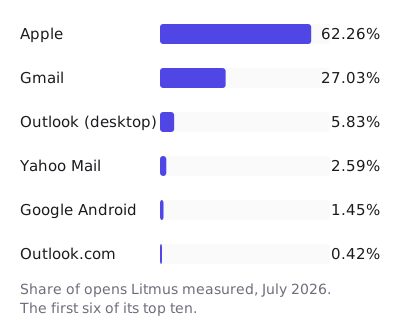
Two definitions change how to read that table. Litmus’s Apple group includes opens from Mail Privacy Protection, and it says those opens “do not pass along specifics of the email client version and platform” and “are not considered reliable opens”. Its Gmail group covers web and both mobile apps, “all reported as via Gmail’s image cache”.
Those rows differ in when they fetch a timer image and whether they animate it. What each client is documented to do, with the vendors’ own sources, is on the email client pages.
How many opens are in dark mode
Litmus’s dark mode guide, dated 27 February 2025, states that “of the opens tracked, an average of 35% used Dark Mode in 2022”. It is a figure for 2022, reported in 2025. What dark mode does to a timer image is in countdown timers in dark mode.
How often countdown timers are fake
These three counts come from websites rather than email. They are the published counts I found of how often urgency on a shop turned out not to be real. The first two count timers alone, and the third groups timers with scarcity claims.
| Who counted | When | What they checked | What they found |
|---|---|---|---|
| Mathur and six co-authors, Princeton University and the University of Chicago | Published November 2019 | 53,180 product pages from 11,286 shopping websites | 393 countdown timers on 361 websites, of which 157 were deceptive, on 140 websites |
| European Commission and national consumer authorities of 23 Member States, Norway and Iceland | The 2022 sweep, published 30 January 2023 | 399 online shops | 42 used fake countdown timers. 148 used at least one of the three dark patterns checked |
| European Commission and 25 countries | Carried out in November and December 2025 | 314 traders, during Black Friday and Cyber Monday | 18% used pressure-selling techniques such as scarcity claims or countdown timers, and over half of those cases appeared misleading |
The 2019 study counted a timer as deceptive in two cases. One was if “the timer reset after timeout with the same offer still valid”. The other was if “the timer expired but the offer it claimed was expiring was still valid even following expiration”. Its crawler revisited the sites that showed a pattern of interest “once every four hours for a period of five days”, and the authors watched the recordings.
The Commission’s sweep, published in January 2023, used almost the same test. A timer counted as fake “when it resets after the expiry with the same offer still valid or it expires but the offer it claimed remains valid even after expiration”. The Commission’s page adds that authorities “concluded that at least 37% of the checked websites potentially violate the Unfair Commercial Practices Directive” through one of the three patterns. What those rules say, and how an email timer stays on the right side of them, is in fake countdown timers.
What urgency does to what people choose
The one experiment I found that tested countdown timers alongside other pressure tactics is by Woon Chee Koh and Yuan Zhi Seah. They tested four patterns on product selection: a low-stock message, an activity message, a countdown timer and a limited-time message. The paper appeared in Cleaner and Responsible Consumption, volume 11, in December 2023.
Its abstract reports “195 adult volunteers aged 19 to 53”. It found that “participants were significantly more likely to select products with dark patterns”. It also found that “The use of limited-time message dark pattern was significantly more effective than other dark patterns in inducing consumption”.
So in that experiment, a plain limited-time message moved choices more than a ticking clock did. It was a study of product selection, not of email, and its abstract gives no conversion rate to quote.
Figures left out, and why
Conversion lift percentages. I found none that led back to a dated test with a method, so none is quoted.
A vendor case study. The most specific test I found is on CountdownMail’s home page, an A/B split described as run for Skylum. Neither the test nor the page carries a date, so its results are not repeated here.
Anything about this product’s customers. No customer results are published, so there are none to report.
Figures about this product
I measured the 47 designs in the EmailTimer.App gallery on 17 September 2026, at all three sizes. All 141 renders were 30-frame GIFs between 9.0 KB and 58.6 KB, with a median of 18.7 KB. The per-design weights and the method are on countdown timer examples, and the plan allowances are on pricing.
Questions and answers
What is the average conversion lift from an email countdown timer?
I could not find one with a dated, published method behind it. The reliable way to get the number is a split test on your own list, with the same offer and the same send time in both halves.
What share of email opens happen in Apple Mail?
In Litmus’s July 2026 report, its Apple group accounted for 62.26% of the opens it measured. That group includes Mail Privacy Protection opens, which Litmus says are not reliable opens.
How common are fake countdown timers?
On shopping websites, common enough to count. A 2019 crawl of 11,286 sites found 157 deceptive timers on 140 of them, and a European sweep of 399 shops, published in 2023, found 42 using fake ones.
Does a countdown timer work better than a written deadline?
In the one controlled experiment I found, a limited-time message influenced choices more than a countdown timer. That was an experiment on product selection, not on email, so treat it as a reason to test both on your own list.
Sources
- Email Client Market Share, July 2026 report (Litmus), read on 17 September 2026
- The Ultimate Guide to Dark Mode for Email Marketers (Litmus, 27 February 2025), read on 17 September 2026
- Dark Patterns at Scale: Findings from a Crawl of 11K Shopping Websites (Mathur et al., Proc. ACM Hum.-Comput. Interact. 3, CSCW, November 2019)
- Consumer protection: manipulative online practices found on 148 out of 399 online shops screened (European Commission, 30 January 2023)
- Sweeps (European Commission, consumer protection enforcement)
- Unintended consumption: The effects of four e-commerce dark patterns (Koh and Seah, Cleaner and Responsible Consumption 11, December 2023)
Related
Put a countdown in the campaign you are writing now
The free plan covers 5,000 opens a month with no card. Starter is $19 a month for 250,000.