Fake countdown timers, and where regulators drew the line
By Danish Mohammed, founder. 7 min read
A countdown timer is not illegal. A countdown timer that lies about the deadline is described, by name or in plain terms, in a US regulator’s report and in EU and UK consumer law. Their own words are quoted below, then applied to email.
I am not a lawyer and this is not legal advice. It is the text of the sources, and what this product does when a deadline arrives.
What the FTC report says
The Federal Trade Commission’s staff report Bringing Dark Patterns to Light was published in September 2022, after a public workshop the FTC hosted on 29 April 2021. Its Appendix A lists common dark patterns. Under the heading URGENCY it names three, and two of them are about deadlines.
The first is the “Baseless Countdown Timer”, described as “Creating pressure to buy immediately by showing a fake countdown clock that just goes away or resets when it times out”. The report’s example is a line reading “Offer ends in 00:59:48”.
The second is the “False Limited Time Message”. The report says it pressures people by claiming a deal ends soon, but “without a deadline or with a meaningless deadline that just resets when reached”. The third, False Discount Claims, is about fake sale prices. In the body of the report, workshop panelists are recorded discussing “countdown timers on offers that are not actually time-limited”.
The FTC’s press release of 15 September 2022 put it in the same terms. It listed “countdown timers designed to make consumers believe they only have a limited time to purchase a product or service when the offer is not actually time-limited”.
The law the report points to is Section 5(a) of the FTC Act. The report quotes it in its second footnote: “unfair or deceptive acts or practices in or affecting commerce . . . are . . . declared unlawful.”
The EU and the UK list it outright
EU consumer law keeps a list of practices that are unfair whatever the circumstances. It is Annex I of the Unfair Commercial Practices Directive, and its heading describes the contents as commercial practices which are in all circumstances considered unfair. The seventh item reads:
Falsely stating that a product will only be available for a very limited time, or that it will only be available on particular terms for a very limited time, in order to elicit an immediate decision and deprive consumers of sufficient opportunity or time to make an informed choice.
The UK’s Digital Markets, Competition and Consumers Act 2024 carries an almost identical line. Its Schedule 20 is headed “Commercial practices which are in all circumstances considered unfair”, and paragraph 7 reads:
Falsely stating that a product will only be available for a limited time, or that it will only be available on particular terms for a limited time, in order to elicit an immediate decision and deprive consumers of sufficient opportunity or time to make an informed choice.
legislation.gov.uk records that paragraph as in force from 6 April 2025.
The UK text drops the word “very”. Both turn on the same word at the start: falsely.
What one European sweep found
In a coordinated check published on 30 January 2023, the European Commission and consumer authorities in 23 Member States, Norway and Iceland screened 399 online shops. 42 of them “used fake countdown timers with deadlines to purchase specific products”.
The Commission’s definition for that check is the most usable test I have found. Its sweeps page says a timer is fake “when it resets after the expiry with the same offer still valid or it expires but the offer it claimed remains valid even after expiration”. The counts from that check and from other studies are collected in countdown timer statistics.
How the test applies to email
Every source above describes the same failure. The clock and the offer disagree. So the question to ask of an email timer is about your store, your billing or your fulfilment, not about the image.
| In the email | The offer behind the clock | Against the definitions above |
|---|---|---|
| A sale email counting to the moment prices go back up | Prices really change at that moment | A real deadline |
| A weekly clock to the dispatch cut-off for delivery that week | Orders after the cut-off really ship the following week | A real deadline that recurs |
| “Your code expires in 24 hours” for each subscriber | The code is issued per person and your system expires it | A real deadline, if it expires for that person |
| The same 24 hour clock on one address shared by the whole list | The discount stays valid for weeks | The clock expires while the offer remains valid |
| “We are holding your items” with a clock | Nothing in the store reserves anything | A false claim, whatever the clock says |
| Last week’s “ends tonight” email sent again with a new clock | The same offer, still available | A reset with the same offer still valid |
The fourth row is the easy one to miss, because the timer itself is behaving correctly. The deadline in the copy is what is false.
What this product does when the deadline comes
These are facts about the renderer, checked against its code on 17 September 2026. They are the parts that decide whether a clock can reset.
A fixed deadline ends for everyone at once. Every fetch after the instant gets the expired state: a single still frame of zeros, or an image you choose. It does not restart. Its headers allow a shared cache to keep that expired image for a week, and a private cache for a day.
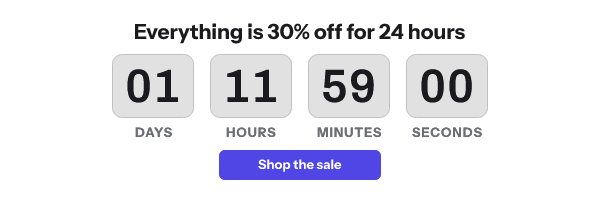
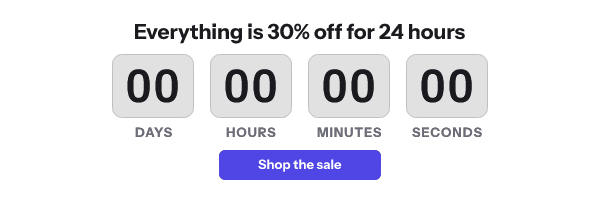
A timer that starts on first open records that open against the image address. Opening the email again does not restart it. With the ordinary snippet the whole list shares one address, so the clock starts at the first open by anybody and ends for everybody together. A clock per person needs an address per person, from a recipient set or the API, on Growth or Agency.
That record does not last for ever. It is kept for the timer’s length plus 30 days, and never longer than a year. Someone who opens an old email after that starts a fresh countdown from the full length, so that open never reaches the expired image, whatever the image says. For an offer that really ends, prefer a fixed deadline or a countdown that starts at send. Each works its end out from the template and the signed image address alone, so there is no record to run out.
A slow store can restart the clock for one open. If the record cannot be read within 50 ms, the renderer falls back to a send time signed into the address. With no send time in the address, that one open counts from the moment of the fetch, so it shows the full duration.
A recurring timer rolls forward by design. After each occurrence it counts to the next one. That is fair only when the thing it counts to really recurs, which recurring countdown timers covers case by case.
Before you send a timer
- Name the system that enforces the deadline: the store, the billing platform or the warehouse. If there is none, remove the clock.
- Make the words agree with the clock. A headline saying “ends Friday” over a clock set to Sunday is a false statement in the picture itself.
- Set the expired state to a message that the offer has ended. A row of zeros invites the question of whether it really has.
- For a clock per subscriber, give each subscriber their own image address and expire the offer per subscriber too.
- When a campaign is resent, change the offer or change nothing. A new clock on the same offer is the reset every source above describes.
What the renderer guarantees about the expired frame and the fallback image is listed on features.
Questions and answers
Is it legal to put a countdown timer in a marketing email?
The texts quoted here are aimed at false deadlines, not at timers. The FTC’s entry is a “fake countdown clock”, and the EU and UK lists begin with “Falsely stating”. Whether a particular campaign is lawful is a question for a lawyer in your market.
Is an evergreen timer a fake timer?
Not by itself. An evergreen clock is truthful when the offer really expires for that person when the clock does. It matches the Commission’s sweep definition of fake when the clock expires and the offer stays valid.
Can I send the countdown again to people who missed the deadline?
You can send them a new offer with its own deadline. Sending the same offer with a fresh clock is what the European Commission describes as a timer that “resets after the expiry with the same offer still valid”.
Does the FTC report apply outside the United States?
The report is about US law. The EU directive and the UK Act quoted above carry their own versions of the rule, in almost the same words.
Sources
- Bringing Dark Patterns to Light (FTC Staff Report, September 2022)
- FTC Report Shows Rise in Sophisticated Dark Patterns Designed to Trick and Trap Consumers (FTC press release, 15 September 2022)
- Directive 2005/29/EC on unfair commercial practices, consolidated text of 28 May 2022, Annex I (EUR-Lex)
- Digital Markets, Competition and Consumers Act 2024, Schedule 20 (legislation.gov.uk)
- Consumer protection: manipulative online practices found on 148 out of 399 online shops screened (European Commission, 30 January 2023)
- Sweeps (European Commission, consumer protection enforcement)
Related
Put a countdown in the campaign you are writing now
The free plan covers 5,000 opens a month with no card. Starter is $19 a month for 250,000.