Email subject lines capitalization, and which case to choose
By Danish Mohammed. 7 min read
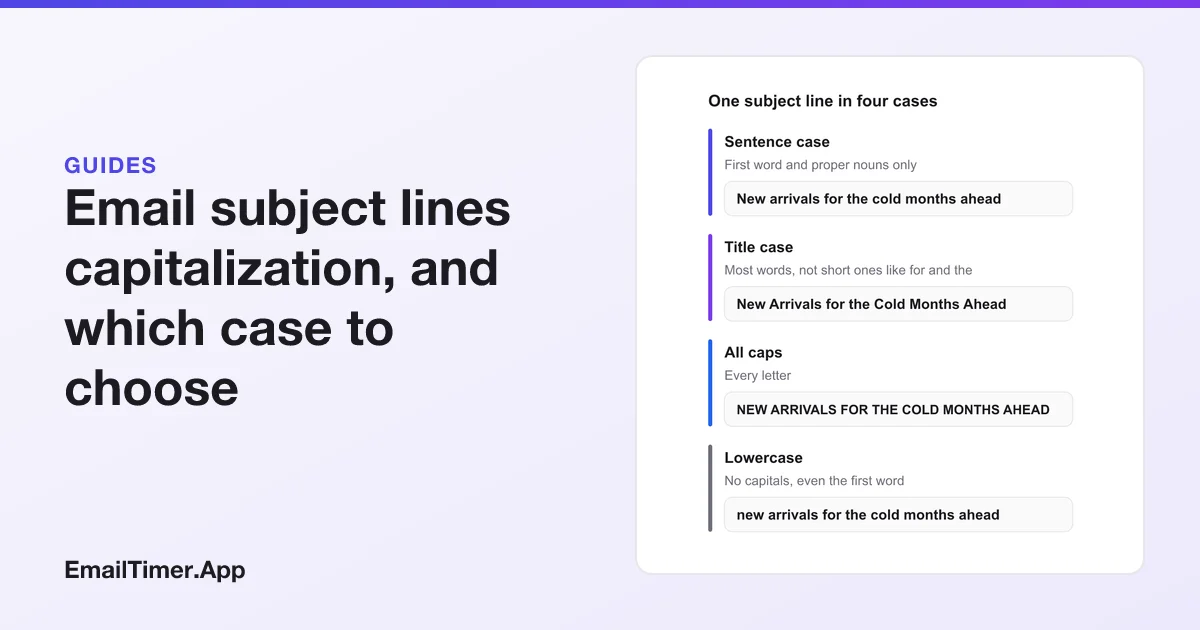
No email standard sets a rule for email subject lines capitalization: RFC 5322 treats the subject as unstructured text. So the choice is a house style, and the Microsoft and Google style guides both choose sentence case for titles. Pick sentence case or title case, use it every time, and keep all caps for single words. An all-caps subject matches a named spam filter rule.
That is the short answer. The rest of this page shows the four cases side by side, the exact rules for title case if you choose it, what happens to merge fields that arrive in capitals, and which words keep their capitals whatever style you pick.
The four cases, side by side
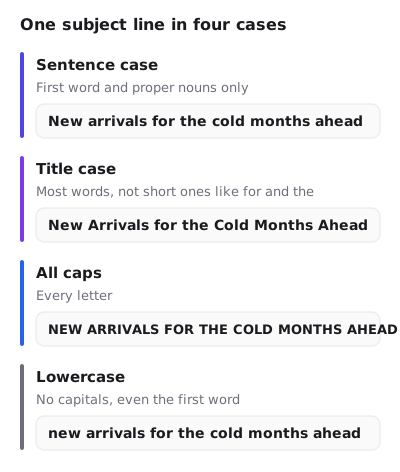
| Case | What gets a capital | Where it fits |
|---|---|---|
| Sentence case | The first word, the first word after a colon, and proper nouns | Most subject lines. It reads like a sentence from a person |
| Title case | Most words, except articles, short conjunctions and short prepositions | A brand that already writes its headings this way |
| All caps | Every letter | One word at most, such as a product code or an acronym |
| Lowercase | Nothing, not even the first word | Rarely. It drops the capitals from names, places and the first word |
What the style guides say
Email has no style authority of its own, so the nearest guidance comes from the companies that publish style guides for their own writing. Two of them are free to read and agree.
The Microsoft Style Guide says: “Use sentence-style capitalization in most titles and headings: capitalize the first word and lowercase the rest.” It extends that to the titles of blog posts, documentation articles and press releases, and it keeps title-style capitalization for a short list of things, such as product names and book titles. On capitals for emphasis it is direct: “Don’t use all uppercase for emphasis.”
The Google developer documentation style guide says the same: “In document titles and headings, use sentence case.” It defines sentence case as capitalizing the first word, the first word of a subheading after a colon, and proper nouns. The Google guide also says not to put a period at the end of a title or heading, which suits a subject line too.
Neither guide is about email, and neither says title case is wrong. They are evidence that sentence case is a reasonable default for short lines of text people read on a screen. A subject line is one of those.
Should email subject lines be capitalized at all?
Yes, at least the first word and every proper noun. A subject line in all lowercase drops the capital from people’s names, product names and places, which changes meaning: “turkey” is a bird and “Turkey” is a country. A sentence-case subject keeps those capitals and loses nothing else.
These words keep their capitals in every style:
- People’s names: Maya, Tom.
- Brand and product names, written the way the owner writes them: iPhone stays iPhone, and EmailTimer.App stays EmailTimer.App.
- Days and months: Friday, November.
- Places and holidays: Chicago, Black Friday, Thanksgiving.
- Acronyms: USA, FAQ, PDF.
Does an all caps subject line hurt deliverability?
It matches at least one published filter rule. Apache SpamAssassin, an open source spam filter, ships a header test called SUBJ_ALL_CAPS, described in its rule file as “Subject is all capitals”. The same file has a rule for a subject that contains both an exclamation mark and a question mark.
What that does not tell you is how much weight any mailbox provider gives it. SpamAssassin adds up the scores of many rules before it decides, and Gmail, Yahoo and Outlook do not publish their filters. Gmail’s sender guidelines ask for headers and content that are “accurate, and not misleading or deceptive”, and they say nothing about capital letters.
So the honest summary: a subject in all caps looks like shouting to a person, matches a named rule in at least one widely used filter, and gains nothing a sentence-case subject cannot do. One word in capitals, such as a code, is a different thing from a whole line of them.
| Example | Reads as |
|---|---|
| LAST DAY FOR 30% OFF EVERYTHING | Shouting, and an all-caps subject in the filter rule’s terms |
| Last day for 30% off everything | Plain and specific |
| Last day: Use code WINTER30 for 30% off | One word in capitals, because it is the code the reader types |
Countdown timers and deliverability covers the other half of that question, the images inside the email.
Title case rules, if you choose title case
Title case is where most capitalization mistakes happen, because the short-word rule has exceptions. The Microsoft Style Guide’s title-style rules are a clear set to adopt:
- Always capitalize the first and the last word.
- Do not capitalize a, an or the unless it is the first word.
- Do not capitalize prepositions of four letters or fewer, such as on, to, in, up, of and for, unless one is the first or last word.
- Do not capitalize and, but, or, nor, yet or so unless one is the first or last word.
- Capitalize every other word, including is and other forms of be, and pronouns such as this, that and its.
- Capitalize the word after a hyphen if it would be capitalized on its own.
Worked examples, with the rule that decides each tricky word:
| Sentence case | Title case | The word to watch |
|---|---|---|
| Your order is on its way | Your Order Is on Its Way | Is and Its are capitalized (rule 5), on is not (rule 3) |
| What to pack for a weekend in the mountains | What to Pack for a Weekend in the Mountains | to, for, a, in and the stay lowercase |
| The back-to-school sale starts Monday | The Back-to-School Sale Starts Monday | to inside the compound stays lowercase, School is capitalized (rule 6) |
| Three things worth signing up for | Three Things Worth Signing Up For | Up and For are capitalized, For because it is the last word (rule 1) |
| Last call: The winter coats are 30% off | Last Call: The Winter Coats Are 30% Off | Off is a short preposition but the last word (rule 1); The after a colon is capitalized in both styles |
The last row shows a rule both styles share: the first word after a colon gets a capital. Microsoft states it for titles and headings, and Google for subheadings.
Mixing styles within one email program looks careless in an inbox where your messages sit one above another. Choose one, write it into your brand notes, and apply it to the preview text too.
Merge fields that arrive in capitals
A subject like “Maya, your order has shipped” depends on the name in your list. If somebody typed their name in capitals at sign-up, the subject prints “MAYA, your order has shipped”, whichever case you chose for the rest of the line. The subject line has no way to fix it, because your sending platform inserts whatever is stored.
Two fixes work. Clean the field when it comes in, so the list holds Maya rather than MAYA. Or, if your platform offers a case filter for merge fields, apply it in the subject line; check your platform’s documentation, because not every one has one.
Inside the email, an image can do this itself. EmailTimer.App runs transforms on a value before it draws it, and one of them is case:
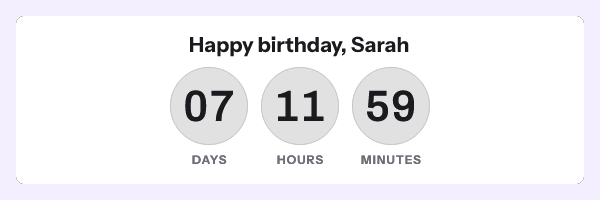
Names and birthdays in personalized images covers the other transforms, including truncating a long name, and the fallback for an empty one.
A capitalization checklist for every send
- One case for every subject line and preview text in the program.
- The first word capitalized, and the first word after a colon.
- Proper nouns, product names and acronyms as their owners write them.
- At most one word in capitals, and only when it is a code or an acronym.
- No period at the end. A question mark is fine when the subject is a question.
- Merge fields checked for names stored in capitals or lowercase.
For what the words themselves should say, see the email subject lines guide.
Questions and answers
Should email subject lines be in title case?
They can be, if that is your house style and you apply it every time. The Microsoft and Google style guides both choose sentence case for titles and headings, which makes sentence case the safer default.
Is sentence case or title case better for open rates?
No dated primary study settles it for email in general. Send both to halves of a slice of your list and keep the one your readers open more.
Is it rude to write a subject line in all caps?
To most readers capitals read as shouting, and Microsoft’s style guide says not to use all uppercase for emphasis. One word in capitals, such as a code, is fine.
Do I capitalize every word in a subject line?
Not in either standard style. Sentence case capitalizes the first word and proper nouns. Title case skips a, an, the, short conjunctions and short prepositions unless they come first or last.
Is capitalization in subject lines a spam signal?
A subject in all capitals matches SpamAssassin’s SUBJ_ALL_CAPS rule. Mailbox providers do not publish how much any single signal counts, and normal capitalization matches nothing.
Sources
- Capitalization (Microsoft Style Guide, Microsoft Learn), read on 29 October 2026
- Capitalization (Google developer documentation style guide), read on 29 October 2026
- rules/20_head_tests.cf, rule SUBJ_ALL_CAPS (Apache SpamAssassin source), read on 29 October 2026
- RFC 5322, Internet Message Format, section 3.6.5 (RFC Editor), read on 29 October 2026
- Email sender guidelines (Gmail Help), read on 29 October 2026
Related
Put a countdown in the campaign you are writing now
The free plan covers 5,000 opens a month with no card. Starter is $19 a month for 250,000.