Welcome email subject lines that deliver what the sign-up promised
By Danish Mohammed. 6 min read
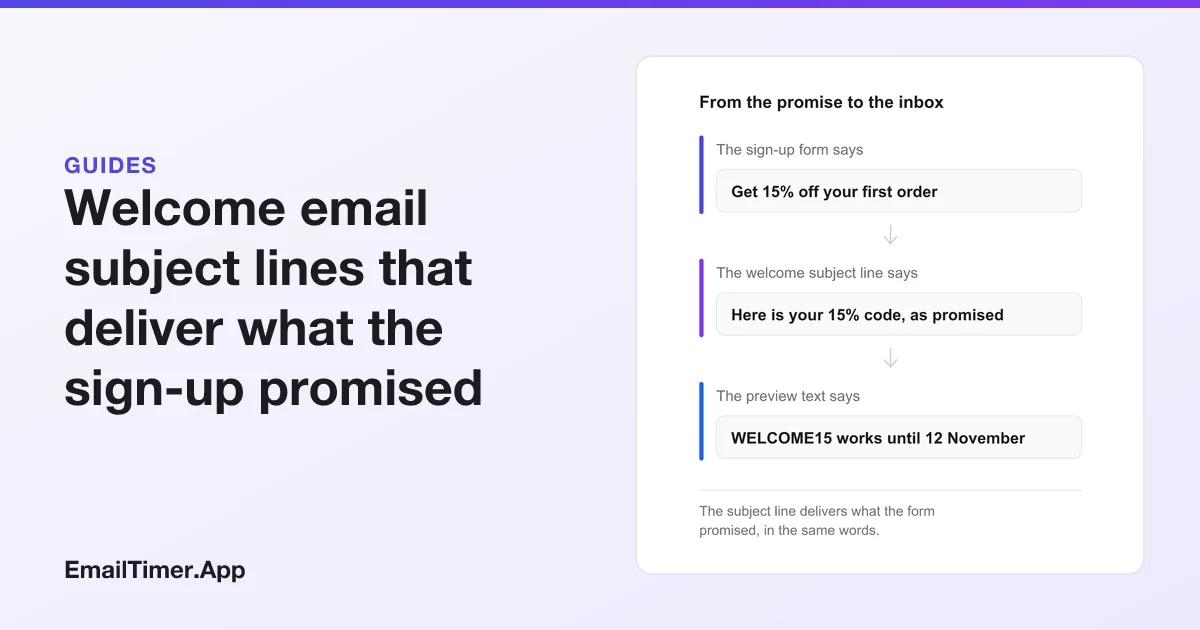
The best welcome email subject lines deliver what the sign-up form promised, in the same words, so the new subscriber recognizes the email the moment it lands. If the form offered a 15% code, the subject says the code is here. If it offered a newsletter, the subject names it. Below are original examples for each kind of sign-up, and the welcome series that follows.
All the examples are written for this page, for an invented store and an invented software product. None comes with an open rate, because none of the figures that circulate for welcome emails has a dated primary source. A welcome email is one the new subscriber is expecting, which makes its subject line easier to get right than most.
The subject line answers the sign-up form
A welcome email is the second half of a conversation the reader started. Whatever your form, pop-up or checkout box said is the promise, and the subject line is where the reader looks to see it kept.
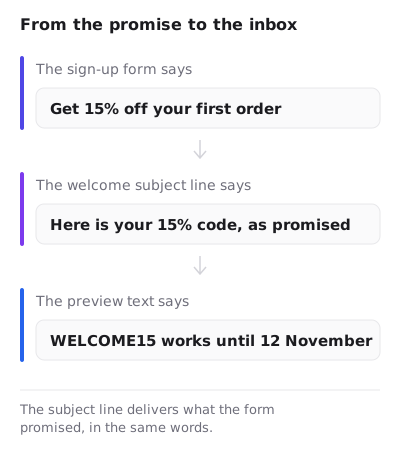
Three things make the match work:
- The sender name. The name in the From header should be the one the reader saw on the form. Gmail’s sender guidelines ask for headers that are “accurate, and not misleading or deceptive”, and a welcome email from an unfamiliar name looks like neither a welcome nor anything the reader asked for.
- The promised thing, named. “Your 15% code”, “The first issue of Field Notes”, “Your account is ready”. The words the form used.
- The detail in the preview text. The code itself, the delivery day of the newsletter, or the first step in the product.
Welcome email subject line examples, by sign-up
When the form offered a discount
| Example subject line | Needs a real deadline? |
|---|---|
| Here is your 15% code, as promised | No |
| Your 15% welcome code is inside | No |
| Your 15% code works until 12 November | Yes, the code expiry |
| Welcome. Your first order ships free | No, unless the offer ends |
When the form offered a newsletter
| Example subject line | Needs a real deadline? |
|---|---|
| You are on the list for Field Notes, every Thursday | No |
| The first issue of Field Notes, and what comes next | No |
| Welcome to Field Notes: Start with these three issues | No |
When the reader created an account
| Example subject line | Needs a real deadline? |
|---|---|
| Your account is ready. Here is the first step | No |
| Welcome, Maya. Your workspace is set up | No |
| Your 14 day trial starts today | Yes, the trial end |
| Three things to try in your first week | No |
When you ask the reader to confirm
| Example subject line | Needs a real deadline? |
|---|---|
| Confirm your subscription to Field Notes | No |
| One click to finish signing up | No |
| Please confirm your email address | No |
A confirmation email exists to get one click, so its subject line should say exactly that and nothing else. Leave the welcome offer for the email that arrives after the click.
Lines that waste the welcome
| Avoid | Why |
|---|---|
| Welcome to Northwind Outfitters | The sender name already says Northwind Outfitters, so the subject repeats it and names nothing |
| Re: Your sign-up | Not a reply. Gmail’s guidelines say not to start a subject with “Re:” unless it is one |
| Hurry, your gift disappears soon | Says nothing about the gift or when |
| Thanks for joining | Polite, and empty of anything the reader came for |
A brand name in a welcome subject is not wrong; it is just already in the row. Spend those words on the thing the reader signed up for.
A welcome series, and how each subject changes
A welcome program is often more than one email. The subject lines should move the reader forward, so each one says something new:
| When | Example subject line | Its job | |
|---|---|---|---|
| 1 | Straight after sign-up | Here is your 15% code, as promised | Deliver the promise |
| 2 | A couple of days later | How our linen shirts are made | Introduce the brand with something worth reading |
| 3 | A few days later | Our most reordered pieces, picked for you | Point at the products |
| 4 | Before the code ends, if it ends | Your 15% code ends Friday at midnight | Remind, with a real deadline |
The timings are an example, not a rule. The fourth email is the only one with a deadline, and it is only honest if the code really stops working on Friday at midnight. The FTC’s 2022 staff report on dark patterns names a deadline that resets or never arrives as a “False Limited Time Message”; fake countdown timers quotes it in full, with the EU and UK rules.
A welcome code with a real deadline
A welcome code that expires is a different deadline for every subscriber, because everyone signed up at a different moment. That is true for the subject line, which needs the end date from your platform, and for any countdown in the email.
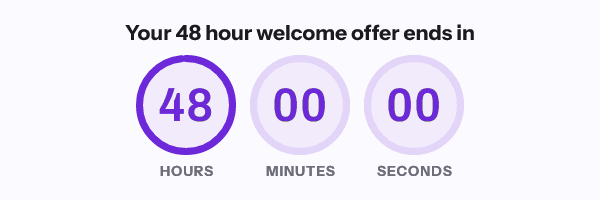
EmailTimer.App draws a per-subscriber deadline from a signed image address minted for each recipient, which is on the Growth and Agency plans. A timer that starts on first open is a different tool, and the evergreen countdown timer guide explains where it fits and where it does not. If a new subscriber starts a cart with the code and leaves, the cart email takes over; the cart abandonment playbook covers that flow and its per-shopper hold.
For a software trial, the welcome email and the trial-end email are the two ends of one clock. Trial and renewal emails shows an end-of-trial countdown image to go with a subject like “Your trial ends on 14 November”.
Is a welcome email commercial?
It depends on what it says. The FTC’s CAN-SPAM guide decides by primary purpose: a message whose primary purpose is “the commercial advertisement or promotion” of a product is commercial. A welcome email that delivers a discount code and shows products reads as commercial, so give it an unsubscribe link and an accurate sender, as you would any marketing email. Yahoo’s sender page asks for the same: no “false or misleading header information or deceptive subject lines”. This is not legal advice; the FTC guide has the full test.
For how to write subject lines for every other kind of email, see the email subject lines guide.
Questions and answers
What is a good welcome email subject line?
One that names what the reader signed up for, in the words the sign-up form used, such as “Here is your 15% code, as promised”. Put the code or the next step in the preview text.
Should a welcome subject line include the brand name?
It can, but the sender name already shows it. If space is short, spend the words on the promised thing instead.
Should the welcome email have a deadline?
Only if the welcome offer really ends. Then name the end in the subject of the reminder, and make sure each subscriber’s end is their own, counted from when they signed up.
How many emails should a welcome series have?
There is no fixed number. The example here has four, each with its own job, and only the last names a deadline.
What should a confirmation email subject line say?
Exactly what you need: “Confirm your subscription to Field Notes”. Keep offers out of it, so the one click is obvious.
Sources
Related
Put a countdown in the campaign you are writing now
The free plan covers 5,000 opens a month with no card. Starter is $19 a month for 250,000.