Click-to-open rate, and when to trust it
By Danish Mohammed. 5 min read
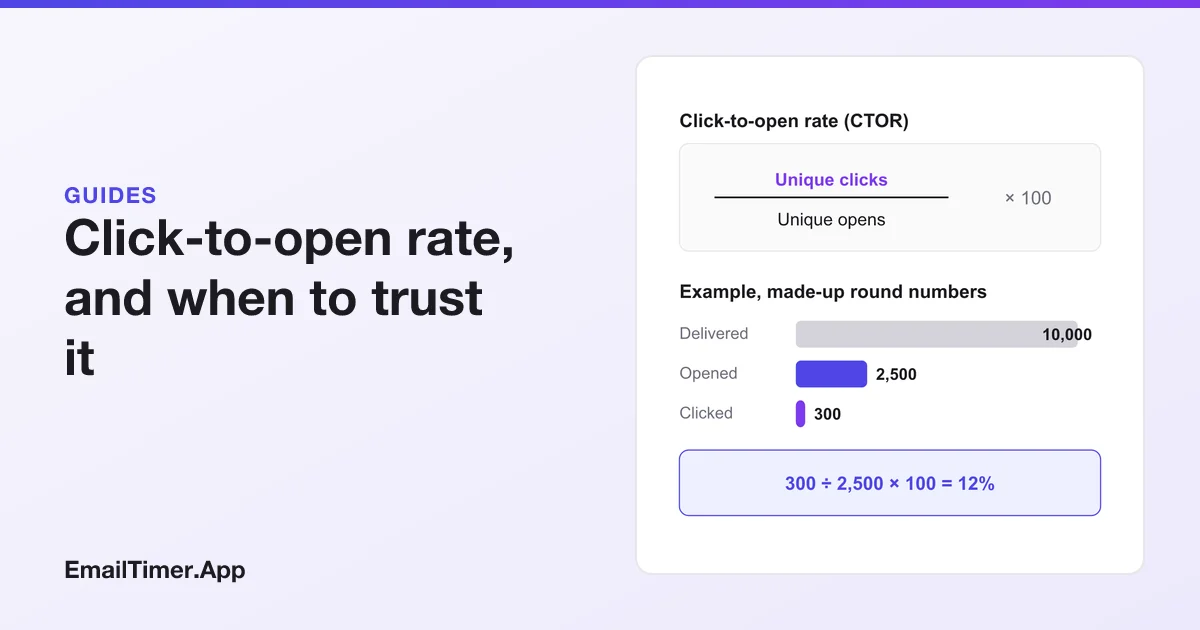
Click to open rate (CTOR) is the share of people who opened an email and then clicked a link in it: unique clicks divided by unique opens, times 100. It measures how well the content earned a click from people who saw it, separate from how many saw it. Because its denominator is opens, it inherits every error in the open count, including machine opens from Apple Mail.
That makes CTOR a useful metric with a known weak point. Below are the formula in the platforms’ own words, a worked example with made-up numbers, how it differs from click-through rate, and a second made-up example that shows how background image downloads can halve it without a single reader behaving differently. The platform pages quoted were read on 29 October 2026.
How do you calculate click to open rate?
Click-to-open rate = unique clicks ÷ unique opens × 100
The sending platforms define it the same way, with small differences in wording:
- Campaign Monitor calculates it by “dividing the number of recipients who clicked by the number of unique opens.”
- Klaviyo’s glossary says that in its email reporting “click-through rate (also called click-to-open rate) is unique clicks divided by unique opens.”
- Mailchimp reports it as “clicks per unique opens”: “The percentage of recipients who registered as an open who also clicked a link in your email.”
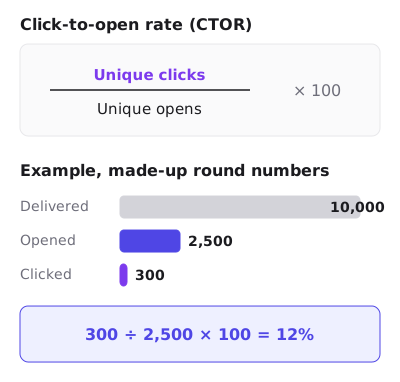
A worked example
Made-up round numbers, to show the arithmetic:
| Step | Number |
|---|---|
| Delivered | 10,000 |
| Unique opens | 2,500 |
| Unique clicks | 300 |
| Click-to-open rate (300 ÷ 2,500 × 100) | 12% |
| For comparison, click-through rate (300 ÷ 10,000 × 100) | 3% |
Both rates use the same 300 clicks. CTOR is four times larger only because 2,500 is a quarter of 10,000. A CTOR is always at least as large as the click-through rate on the same send, because opens can never exceed deliveries.
CTOR vs CTR: which one should you report?
| Click-through rate | Click-to-open rate | |
|---|---|---|
| Formula | Unique clicks ÷ delivered | Unique clicks ÷ unique opens |
| Answers | How many of everyone reached clicked? | Of those who opened, how many clicked? |
| Depends on the tracking image | No | Yes, through the opens |
| Moved by subject line | Yes, indirectly | Not directly; the subject line changes who opens |
| Moved by Apple’s background downloads | Not directly, since opens are not in the formula | Yes, downward |
The idea behind CTOR is sound: the subject line decides the opens, the content decides the clicks, so dividing by opens isolates the content. The trouble is that “opens” no longer means “people who saw it”. Email click-through rate covers the other metric, and the warning that some platforms call CTOR “click-through rate”. Read the denominator, not the label.
Why Apple Mail Privacy Protection lowers CTOR
An open is recorded when a tiny image in the email is downloaded. Mailchimp’s page on open tracking describes it as “a tiny invisible graphic in the bottom of your HTML email”. Apple’s page on Mail Privacy Protection says Protect Mail Activity “downloads remote content in the background by default”, “regardless of whether you engage with the email”. The tracking image is remote content, so it is downloaded and an open is logged whether or not the reader looks.
A machine open adds to the denominator and never adds a click. So the more of your list reads in Apple Mail with Protect Mail Activity on, the lower your CTOR can go, even if every human reader behaves exactly as before.
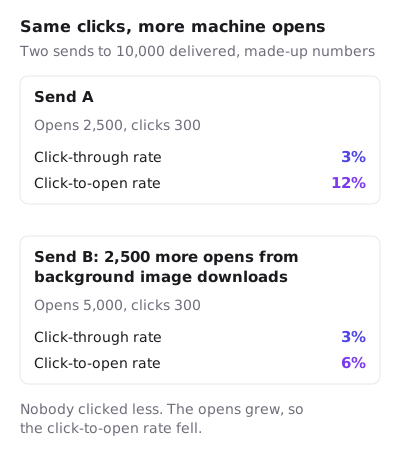
Campaign Monitor’s help page names the same change: since September 2021, “open rates and click-to-open rates (CTOR) will become less reliable”. Apple’s mechanism, and what testing has reported about how long Apple keeps the downloaded copy, is set out in how Apple’s image cache freezes a countdown.
When CTOR is still worth reading
CTOR still works for comparisons where the machine opens are roughly the same on both sides:
- Two versions of one email, sent at the same time to a random split of one list. The share of Apple readers is the same in both halves, so the difference in CTOR comes from the content.
- The same newsletter week after week, to a stable list, watched for a sudden change rather than read as a level.
- Reports with machine opens filtered out. Mailchimp’s report shows a field for whether “bot filtering for email opens (Apple MPP)” is on. If your platform filters, CTOR on filtered opens is closer to what the metric was meant to measure.
It is weak for comparing lists, platforms or years, and for any number published by someone else, because the share of machine opens and the filtering differ for each.
What moves click-to-open rate
CTOR is about the body of the email: what a reader sees after opening and whether it gives them a reason and a way to click. Things to check, none of them a promised lift:
| Part of the email | What to check |
|---|---|
| The first screen | Does the reason to click appear before scrolling, on a phone? |
| The main link | Is there one clear action, repeated, in live text or a coded button? |
| Link text | Does it say where it goes? |
| Images off | If the offer is in a picture, is it also in text, and is the link still clickable? |
| Match with the subject line | Does the body deliver what the subject promised? A mismatch opens and does not click. |
Timing is one part of the body a picture can show at a glance. A countdown timer puts the time left in the first screen, and the HTML for an email countdown timer shows it wrapped in a link with alt text that carries the deadline, so the image still says something with images off. To compare CTOR with and without one, send both versions at the same time to a random split; the machine opens then cancel out.
Questions and answers
What is the formula for click to open rate?
Unique clicks divided by unique opens, times 100. With 300 unique clicks and 2,500 unique opens, CTOR is 12%.
What is the difference between CTR and CTOR?
The denominator. Click-through rate divides unique clicks by delivered emails; click-to-open rate divides them by unique opens. On the same send CTOR is always the larger number.
What does CTOR mean?
Click-to-open rate. Mailchimp’s reports call the same idea “clicks per unique opens”, and Klaviyo’s glossary lists it as another name for its email “click-through rate”.
Why did my click-to-open rate drop when clicks stayed the same?
Opens went up without clicks following. A common cause is machine opens, such as Apple Mail downloading images in the background, which add to the opens and never click. Check whether your platform’s bot filtering changed too.
Can CTOR be over 100%?
It should not. The usual cause is total clicks divided by unique opens, so one person clicking several links counts several times. The other is a platform that does not count a click as an open: a reader with images off can click without the tracking image loading. Mailchimp counts such a click as an open for that reason.
Sources
- Open and click rates (Campaign Monitor Help), read on 29 October 2026
- Advertising glossary (Klaviyo Help Center), read on 29 October 2026
- About Email Reports (Mailchimp Help), read on 29 October 2026
- Use Open Tracking in Emails (Mailchimp Help), read on 29 October 2026
- Mail Privacy Protection and Privacy (Apple Legal), read on 29 October 2026
Related
Put a countdown in the campaign you are writing now
The free plan covers 5,000 opens a month with no card. Starter is $19 a month for 250,000.