Abandoned cart email subject lines, from the reminder to the last nudge
By Danish Mohammed. 6 min read
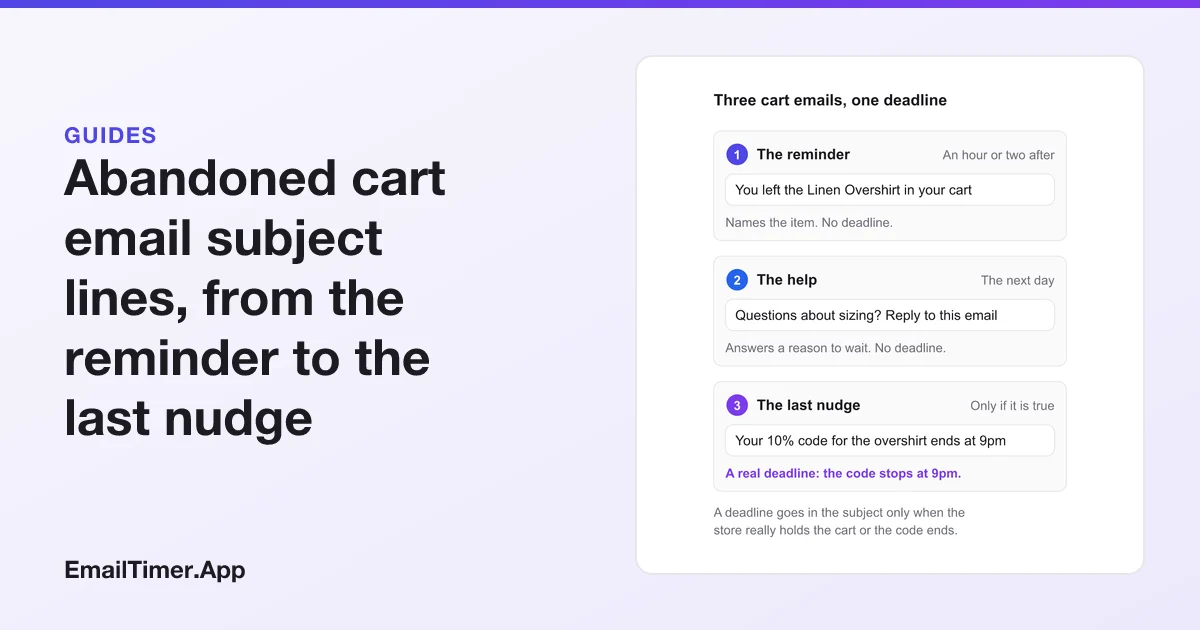
A good abandoned cart email subject line names the item the shopper left, reads like a reminder rather than an alarm, and only mentions a deadline when the store really holds the cart or a code really ends. The first email reminds, the second helps, and a last one can make an offer. Below are original examples for each, and the line between a real hold and a fake one.
Every example on this page was written for it, for an invented clothing store. No example comes with a recovery rate, because none of the rates in circulation has a dated primary source behind it. Test on your own flow.
Why the shopper’s own cart is the best subject
A cart email is not a broadcast. It goes to one person about one cart, and it can exist only because that person gave you their address before they left. Shopify’s help center puts the condition precisely: a checkout “is considered abandoned if it remains incomplete for more than ten minutes” after the customer has provided their email information. You choose how long after that the email goes out.
So the subject line can say something no campaign subject can: the name of the thing this reader picked. “You left the Linen Overshirt in your cart” is specific, true and impossible to send to the wrong person, which is more than any generic “Did you forget something?” can claim.
Two practical limits: a product name merged into a subject line prints exactly as your catalogue stores it, so a long name (“Linen Overshirt, Relaxed Fit, Sage, Size M”) pushes everything after it off the screen. Put the product name last, or use a short version of it, and keep the words that explain the email in front.
A three-email cart flow, and what each subject says
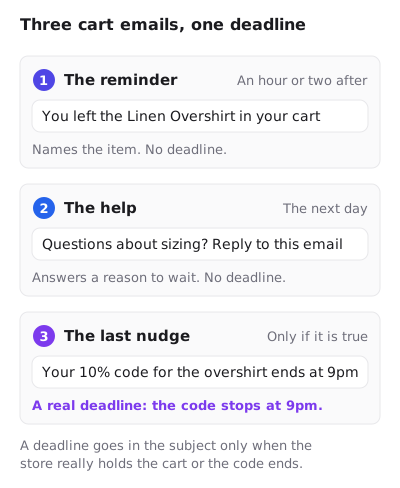
The timing in the figure follows the cart abandonment playbook, which suggests the first email an hour or two after the shopper leaves, while the cart is still a live decision. The second and third are later and optional. What matters for the subject line is that each email has a different job, so each subject says a different thing.
Abandoned cart email subject lines, by email
The reminder
| Example subject line | What it does |
|---|---|
| You left the Linen Overshirt in your cart | Names the item |
| Your cart is saved: Linen Overshirt, size M | Names the item and the size |
| Still deciding on the overshirt? | A question the reader can answer by clicking |
| Here is the cart you started on Tuesday | Names when, for a reader who shops in several places |
The help email
| Example subject line | What it does |
|---|---|
| Questions about sizing? Reply to this email | Invites a reply, which a real person reads |
| Free returns for 30 days on your overshirt | Removes a reason to wait, if your policy says it |
| How the Linen Overshirt fits, from our size guide | Points at an answer |
| Shipping to Chicago takes 2 to 4 days | A fact about delivery, if you can promise it |
The last nudge
| Example subject line | Needs a real deadline? |
|---|---|
| Your 10% code for the overshirt ends at 9pm | Yes, the code expiry |
| We are holding your size M until tomorrow at noon | Yes, a real hold |
| Free shipping on your cart, today only | Yes |
| Your cart is still here when you are ready | No |
The last row is a reasonable final email for a store that gives no discount. It is honest, and it leaves the door open without inventing pressure.
When a cart deadline in the subject line is honest
“Your cart expires in 2 hours” is only true if something happens in 2 hours. Unless your store is built to release the stock or end a price, nothing does: the cart, or the link back to it, just sits there. A deadline the store does not enforce is what the FTC’s 2022 staff report on dark patterns calls a “False Limited Time Message”, and a fake clock is its “Baseless Countdown Timer”. Fake countdown timers quotes the report and the EU and UK rules in full.
| Subject line claim | Honest when |
|---|---|
| Your cart is held for 24 hours | Your store reserves the stock for that shopper for 24 hours |
| Your code ends at 9pm | The code stops working at 9pm |
| Only 2 left in your size | Your stock count says 2 when the email is sent |
| Prices go up tomorrow | The price really changes tomorrow, for everyone |
| Your cart expires soon | Something specific happens, and you can say when |
When the hold or the code is real, it is a different deadline for each shopper, because each one left at a different time. A subject line can name it with a merge field if your platform stores the end time. Inside the email, an image can count down to it:
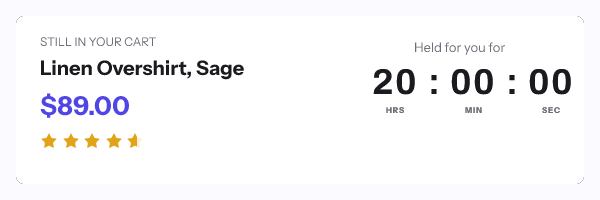
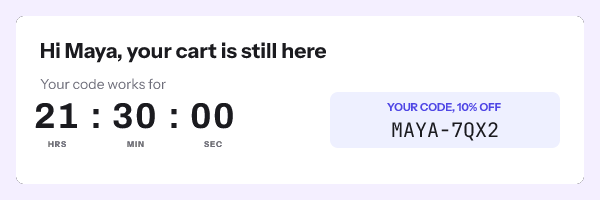
A deadline per shopper is drawn from a signed image address made for each recipient, which is on the Growth and Agency plans; the cart abandonment playbook explains the setup, and product and cart images shows the item, price and rating in the same picture.
Subject lines to avoid in cart emails
| Avoid | Why | Instead |
|---|---|---|
| Re: Your order | It is not a reply, and there is no order yet. Gmail’s guidelines say not to start a subject with “Re:” unless it is a reply | You left the Linen Overshirt in your cart |
| Your order is waiting | The shopper did not place an order. The CAN-SPAM guide says the subject must reflect the content | Your cart is saved: Linen Overshirt |
| FINAL WARNING | Capitals read as shouting, and nothing final is happening | Your cart is still here when you are ready |
| Your cart expires in 1 hour | Unless your store enforces it, the deadline is false | We are holding your size M until noon, if you are |
| We noticed you left | True, and a little unsettling, with nothing to act on | Still deciding on the overshirt? |
A cart email is commercial: it asks the shopper to buy. The FTC’s CAN-SPAM guide treats a message as commercial when its primary purpose is promoting a product, and it says that a subject line which would lead a recipient to think a message is commercial counts toward that. So the usual rules for marketing email apply, including an unsubscribe link. This page is not legal advice; the FTC guide has the full test.
Questions and answers
What is a good abandoned cart email subject line?
One that names the item the shopper left, such as “You left the Linen Overshirt in your cart”. It is specific to that reader and true by definition.
Should I put a discount in the first cart email?
That is a business decision, not a subject line rule. If you offer one, name the amount and the real end in the subject.
Can the subject line include the shopper’s name?
Yes, with a merge field, if the name is in your data. Check how it is stored, because a name saved in capitals prints in capitals.
Is “your cart expires” a fake urgency line?
It is if nothing happens when the time runs out. Say it only when your store really releases the stock or the code really stops working.
How many abandoned cart emails should I send?
There is no fixed number. The flow on this page uses three, each with a different job, and the last one is honest about there being no deadline when there is none.
Is an abandoned cart email transactional?
Under the FTC’s primary purpose test it reads as commercial, because it asks for a sale that has not happened yet. This is not legal advice; treat it as marketing email, with an unsubscribe link.
Sources
Related
Put a countdown in the campaign you are writing now
The free plan covers 5,000 opens a month with no card. Starter is $19 a month for 250,000.