

Email personalization is choosing part of what each subscriber receives, such as the greeting, the products, the offer or the deadline, from data you hold about them. The useful kind climbs a ladder: name and stated facts, then behavior, then lifecycle stage, then deadlines and values that belong to one person. Each rung needs more data, and more care about how you got it.
Most of it runs inside email automation, because a flow that fires on an event already knows who triggered it and why. This page is the strategy: what to personalize on each rung, examples by flow, the ways it goes wrong, and what the UK regulator, the GDPR and the FTC expect of the data behind it. How the content is built (merge fields, conditional blocks, images drawn at open) is covered in dynamic content in email.
What is a personalized email?
A personalized email is one where at least one part was chosen for that reader from data about them. “Hi Maya” counts, and so does an email that leaves out the product she bought yesterday.
Email segmentation decides who gets an email at all, and dynamic content is the machinery that swaps the parts. Personalization is the decision in between: which part should differ, for whom, and on what evidence.
The personalization ladder: what to personalize, and with which data
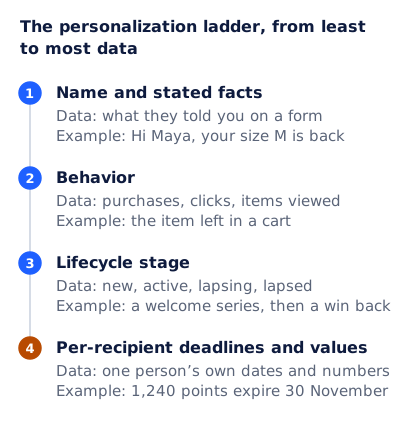
| Rung | Data it needs | Where that data comes from | Example | What it costs when it is wrong |
|---|---|---|---|---|
| 1. Name and stated facts | First name, size, city, birthday | What they told you on a form or in a preference center | “Hi Maya, your size M is back” | A wrong or empty name, in front of the reader |
| 2. Behavior | Purchases, clicks, items viewed | Your store and site events | The item left in a cart | An email that feels like being watched |
| 3. Lifecycle stage | New, active, lapsing, lapsed | Order and engagement history over time | A welcome series, then a win back | A discount sent to someone who paid full price yesterday |
| 4. Per-recipient deadlines and values | One person’s own dates and numbers | Your systems of record: loyalty, billing, bookings | 1,240 points expire 30 November | A date or a balance that is not true |
Rung 1: name and stated facts
The cheapest rung, and the one readers notice first when it breaks. These are things the subscriber typed into a form, so using them surprises nobody. The work is in the data quality. Names arrive in capitals, with typos, or belonging to someone else (the person who bought a gift, a shared family account). A name inside a designed image has its own failure modes, from very long names to all capitals, and images with your subscriber’s name in them goes through how to handle each one.
Rung 2: behavior
What someone bought, clicked or looked at. This is where personalization starts to pay, because it answers the reader’s own question (“is the thing I wanted still there?”). It is also where the UK regulator starts paying attention. The ICO’s direct marketing guidance describes profiling as looking at “people’s interests, habits and behaviour”, and says you “must tell people about your profiling and clearly explain to them what you will be doing”. Its own example of a notice that does this is one sentence: “We will use your purchase history to tell you about our offers and products that we think you will be most interested in.”
Rung 3: lifecycle stage
Where someone is in their relationship with you: new, active, lapsing, lapsed. Stage changes what an email should be about more than any product data does. Someone who ordered yesterday needs their order, not a sale. Lifecycle email marketing maps the flows to each stage. For personalization, the most useful lifecycle rule is often a suppression: do not send the promotion to the people it would insult.
Rung 4: per-recipient deadlines and values
The top rung is data that belongs to one person and changes the action they should take: points that lapse on their own date, a trial that ends on their own day, a booking, a balance, a code. It is the most useful rung and the least forgiving: a wrong balance is not a cosmetic error.
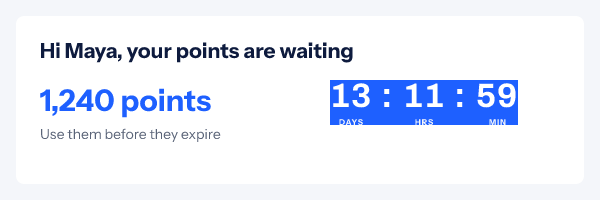
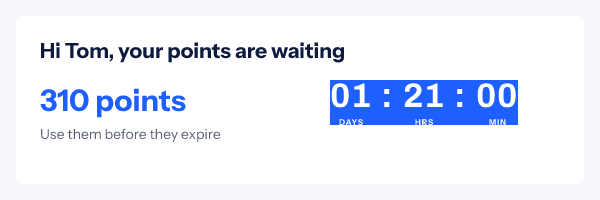
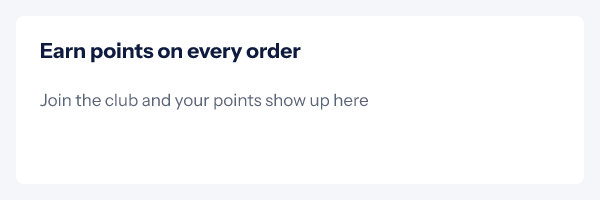
Values like these are where an image drawn at open earns its place: the time left is worked out when the email is opened, so a reminder sent on Monday is still right on Thursday, within what a mail client has cached. In EmailTimer.app each subscriber’s balance and date travel in a signed image address minted for that person, on the Growth and Agency plans, and personalized images covers what else can be drawn per person.
Email personalization examples by flow
| Flow | Trigger | What to personalize | Rungs used |
|---|---|---|---|
| Welcome | Sign-up | What they signed up for, the preferences they gave | 1 |
| Abandoned cart | A cart left without checkout | The item, size and price, and how long it is held | 2, 4 |
| Post-purchase | An order | How to use what they bought; a reorder reminder timed to when it runs out | 2, 3 |
| Birthday | A date field | The name, and a reward that lasts a set number of days | 1, 4 |
| Win back | No clicks for a set period | What they used to buy, a points balance that is about to lapse | 3, 4 |
| Trial ending or renewal | A billing date | Their plan, their date, what changes for them on that date | 3, 4 |
The rungs combine. A birthday email is rung 1 (they gave you the date) and rung 4 (the reward window is theirs). The birthday email use case builds one in full. Here is its skeleton, with every personalized slot marked and its fallback beside it:
Subject: Happy birthday, [first name]   (no name: "A birthday gift from us")
Preheader: Your gift is good until [reward end date]

Hi [first name, or "there"],

Happy birthday from everyone at [store].
Your gift: [reward by tier: 15% off for Gold, 10% off for everyone else]
It is yours until [reward end date, 7 days after the birthday].

[Image: their name and the time left on the gift, drawn at open]

[Use my gift]

You are getting this because you told us your birthday when you joined.
Change it, or stop birthday emails: [preferences link]
The last two lines tell the reader where the data came from, and how to correct it or stop.
Where personalization goes wrong
The wrong name, or none
An empty field prints “Hi ,” unless every merged field has a default. Article 5 of the GDPR also requires personal data to be “accurate and, where necessary, kept up to date”. If a field is often wrong (names typed by the buyer of a gift, for instance), keep it out of the subject line, where an error is the first thing anyone sees.
Faking personal context is worse than leaving it out. A subject line that starts “Re:” or says “Your order” when there is no conversation and no order is a trick, and the FTC’s CAN-SPAM guide is short on the point: “Don’t use deceptive subject lines.”
Creepy use of browsing data
The ICO’s guidance accepts that tailoring to the kind of product someone buys is ordinary profiling, but warns that it can be “more intrusive, for example due to the type of information used (eg health, financial), or the amount being gathered on someone”. Three questions keep you on the right side:
- Would they expect it? The ICO’s fairness test is “not doing anything with personal information that people would find unexpected, misleading or detrimental”. “You looked at this four times” fails it; showing the item they left in a cart usually does not.
- Is it a special category? Health, religion, sexual orientation and the other categories in Article 9 of the GDPR are off limits by default. The ICO says that profiling with them for direct marketing means “you are likely to need explicit consent”. A store that infers a pregnancy or an illness from purchases should not mail on that inference.
- Who else reads the inbox? A shared family inbox or tablet turns “still thinking about the engagement ring?” into a spoiled surprise. For products people buy as gifts, personalize by category rather than by the exact item.
The right data at the wrong stage
Behavior data without lifecycle context sends “complete your purchase” to someone who bought in the store, or a first-order discount to a customer of five years. Check that the trigger’s data is current at the moment of sending.
How do you know personalization is working?
Hold some people back. Send the plain version to a random slice of the flow’s audience, such as one in ten, and the personalized version to everyone else, then compare clicks and orders per recipient over a fixed period. Leave opens out of it: Apple’s Mail Privacy Protection downloads remote content “regardless of whether you engage with the email”, so an open no longer proves a read. Change one rung at a time, or you will not know which one paid.
What privacy law and consent require of the data you use
This is a summary of what regulators publish, not legal advice for your program.
In the UK and the EU, the GDPR defines profiling as automated processing “to evaluate certain personal aspects relating to a natural person”, including their “personal preferences, interests, reliability, behaviour, location or movements”. Most behavioral personalization fits that definition. Article 5 asks for data that is “processed lawfully, fairly and in a transparent manner”, and “limited to what is necessary”. Article 21 gives every subscriber “the right to object at any time” to processing for direct marketing, “which includes profiling to the extent that it is related to such direct marketing”, and once they object, “the personal data shall no longer be processed for such purposes”. The ICO adds that you “must have a data protection reason (‘lawful basis’) for your profiling activity”.
Tracking has its own rule. Personalizing on who opened what relies on a tracking pixel, and the ICO says “Tracking pixels are covered by PECR’s separate rules on storage and access technologies”.
In the US, the FTC’s business guidance holds you to what you said when you collected the data: if you make privacy promises, “either expressly or by implication”, then “the FTC Act requires you to live up to those claims.” FTC staff wrote in February 2024 that “A business that collects user data based on one set of privacy commitments cannot then unilaterally renege on those commitments after collecting users’ data.”
| Before you use a field, ask | UK and EU | US |
|---|---|---|
| Did we tell them we would use it this way? | The ICO says to tell people about profiling and explain it clearly | The FTC Act holds you to the privacy promises you made |
| Is it health, religion or another special category? | Article 9 prohibits it by default; the ICO says explicit consent is likely needed | The FTC Act holds you to what your privacy promises say about it |
| Is it accurate and current? | Article 5 requires accuracy | A deadline that is not real is its own problem: see fake countdown timers |
| Does an objection or unsubscribe stop it? | Article 21: profiling for marketing stops when they object | CAN-SPAM: honor an opt-out “within 10 business days” |
| Did the policy change after we collected it? | Article 5: no further use “incompatible with those purposes” | FTC staff: a retroactive change can be unfair or deceptive |
Questions and answers
What is email personalization?
Choosing part of each subscriber’s email, such as the greeting, the products, the offer or a deadline, from data you hold about them. It ranges from a first name to a deadline that belongs to one person.
What are good email personalization examples?
The item left in a cart with how long it is held, a birthday reward with its own end date, a points balance before it lapses, and a renewal email with the reader’s own plan and date.
Does email personalization need consent?
Sending marketing email needs its own lawful basis. Personalizing it with behavioral data counts as profiling under the GDPR, which needs a lawful basis and must be explained to people; special category data usually needs explicit consent. In the US, the FTC expects you to use data only as your privacy promises said.
Is a first name in the subject line enough?
It is the first rung, not the goal. A name shows you have their record; behavior, stage and their own deadlines show you have something useful to say.
Can personalization be too much?
Yes, when it shows the reader more about your tracking than about their interests. The ICO’s test is whether people would find the use “unexpected, misleading or detrimental”.
Sources
- Collect information and generate leads, Direct marketing guidance (Information Commissioner's Office, UK), read on 3 November 2026
- What else do we need to consider?, Guidance on direct marketing using electronic mail (Information Commissioner's Office, UK), read on 3 November 2026
- Regulation (EU) 2016/679, the General Data Protection Regulation, Articles 4, 5, 9 and 21 (EUR-Lex), read on 3 November 2026
- Privacy and Security, business guidance (Federal Trade Commission), read on 3 November 2026
- AI (and other) Companies: Quietly Changing Your Terms of Service Could Be Unfair or Deceptive (FTC Office of Technology and Division of Privacy and Identity Protection staff, 13 February 2024), read on 3 November 2026
- Mail Privacy Protection and Privacy (Apple Legal), read on 3 November 2026
- CAN-SPAM Act: A Compliance Guide for Business (Federal Trade Commission), read on 3 November 2026
- Photo by Alina Skazka on Pexels
Related
Put a countdown in the campaign you are writing now
The free plan covers 5,000 opens a month with no card. Starter is $19 a month for 250,000.