
A final reminder email is the last message you send before a real deadline: a sale ending, an offer expiring, registration closing or a payment falling due. Send it once, a few hours to a day before the cut-off, only to people who have not acted yet, and say exactly when the deadline is and what happens after it.
In a marketing program it is a deadline-triggered automation: the send time is worked back from the deadline, and the audience is whoever is still eligible when it goes. For a sale, most people call it a last chance email. This page covers when it is worth sending, how far ahead, who to leave out, what it says, four templates, and the rules on honest urgency. Subject lines for it are in the sale subject line guide, so they are not repeated here.
When is a final reminder email worth sending?
When all four answers below are yes. If any is no, the email is either false or wasted.
| Question | Send it if | Skip it if |
|---|---|---|
| Does something change at the deadline? | The price goes back up, the code stops working, registration closes | The offer quietly carries on |
| Is this the last deadline? | Yes | The sale gets extended, or runs again next week |
| Has this person acted? | Not yet | They bought, registered, renewed or paid |
| Can they act in the time left? | Yes | They need a sign-off or a payment run they cannot get by then |
The second row is the one that goes wrong. “Last chance” is a promise about the future, and a sale that comes back a week later breaks it for everyone who hurried.
How long before the deadline should it go?
Far enough ahead that the reader can still act, and close enough that the deadline is the news. That gap depends on what the reader has to do.
| Deadline | When to send the final reminder | Why |
|---|---|---|
| A sale ending at midnight | The morning of the last day | A whole day to decide, without landing in the final hour |
| A flash sale of a day or two | 3 to 6 hours before the end | A short sale needs a short reminder |
| A personal offer, such as a trial or a code with its own expiry | 24 hours before that person’s expiry | Each deadline is different, so it is a flow step, not a campaign |
| Registration closing | 1 to 2 days before | People may need approval or a free slot in the calendar |
| A renewal or a payment due | 3 to 7 days before | Updating a card or getting an invoice approved takes time |
These are starting points to test, not measured optimums. And send one. A second “final” reminder makes the first one untrue.
Who should not get the final reminder?
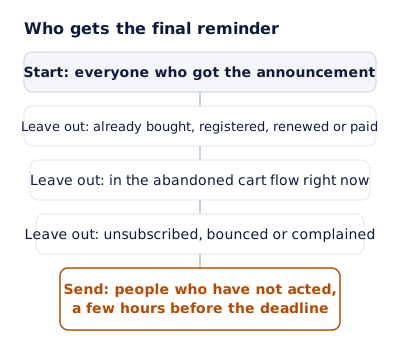
Anyone who already did the thing. A “last chance to save 30%” sent to someone who bought in the sale yesterday reads as a mistake, and to someone who paid full price the week before it reads worse. Complaints follow, and they count against you: Google’s sender guidelines say “Keep spam rates reported in Postmaster Tools below 0.10% and avoid ever reaching a spam rate of 0.30% or higher”, and that “you should send email only to people who want to get messages from you.”
Two other groups come out. Shoppers already in an abandoned cart email flow are getting emails about the same items, and a sale reminder on the same afternoon is one email too many. And people who registered for an event need a different email altogether: the event reminder that tells them when and where.
Here is the segment, written out for a sale:
Final reminder: autumn sale, ends 8 November at 00:00 ET

Include:  received the sale announcement
Exclude:  placed an order since the sale began (5 November)
Exclude:  entered the abandoned cart flow in the last 3 days
Exclude:  unsubscribed, bounced, or marked an email as spam
Send:     7 November at 10:00 ET, 14 hours before the end
What does a final reminder email say?
Four things, and nothing new.
- The deadline in words, with a time zone. “Ends tonight at midnight ET (9pm PT).” A reader in California who sees only “midnight” will plan for the wrong hour.
- What happens at it. “Prices go back to normal.” “Registration closes and the waitlist opens.” “Your card is charged.”
- One action. One button, the one that meets the deadline.
- How long is left, right when they read it. That is the job of a countdown image, covered below.
Leave out the new offer. A last chance email that announces a bigger discount teaches the list to wait for the last email. The subject line has to match what is inside, too: the FTC’s CAN-SPAM guide says “The subject line must accurately reflect the content of the message.”
Final reminder email examples and templates
Four templates, one per kind of deadline. Fill the brackets; leave out any line that is not true for you.
A sale ending
Subject: [Sale name] ends tonight at midnight ET
Preheader: [X]% off [range] until 11:59pm ET. Full prices after that.

[Countdown image: hours and minutes to midnight ET]

The [sale name] ends tonight.
At midnight ET (9pm PT) prices go back to normal. This is the last
email we will send about it.

[Shop the sale]

[store name], [postal address]   [unsubscribe]
An offer expiring
Subject: Your [offer] ends tomorrow at [time, zone]
Preheader: Code [CODE] works once, until [date, time, zone].

Hi [first name],

Your [offer] ends tomorrow at [time, zone]. After that the code
stops working and the price is the regular one.

[Use your code]
Registration closing
Subject: Registration for [event] closes [day] at [time, zone]
Preheader: [Date, time, zone], [online or venue]. [Price or free].

Registration for [event] closes on [day] at [time, zone].
After that the form closes and the recording goes only to people
who registered.

[Register now]
A renewal or payment due
Subject: Your [plan] renews on [date] for [amount]
Preheader: Nothing to do if your card is current. Changes by [date].

Hi [first name],

Your [plan] renews on [date] for [amount], charged to the card
ending [1234]. To change your plan or cancel, do it before
[date, time, zone].

[Manage your plan]
The last one is a different kind of email. A renewal or payment notice is about an account the reader already has, which puts it close to the FTC’s list of transactional or relationship content, such as a message that “notifies the recipient about a change in the terms or features of a membership, subscription, account”. Keep sale offers out of it. A countdown to a promotion does not belong there either.
The countdown in a final reminder
A sentence like “six hours left” is true when you write it and wrong when it is read. A countdown image drawn at the moment of opening is not. EmailTimer.app draws the timer when the email is opened, so the hours shown are the hours left at that moment, and classic Outlook, which shows only the first frame, gets a complete reading in that frame.
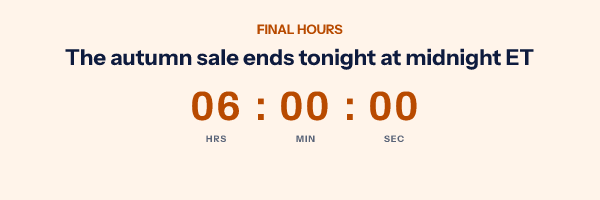
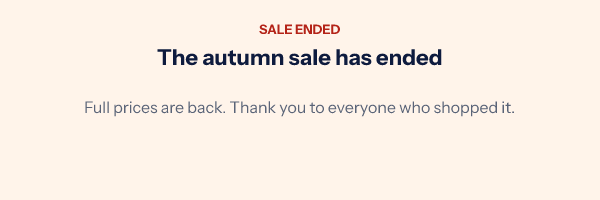
The second state matters as much as the first. People open email late, and someone who opens the final reminder the next morning should see that the sale ended, not a clock stuck at zero. In an account you design that ended state yourself.
For a single deadline that is the same for everyone, the free countdown timer generator is enough. A timer from the free generator works for 500 opens without an account, and for 1,000 once you sign in and claim it. After its deadline it shows the design at zero with “Offer ended” under it. An offer that expires at a different time for each person needs that person’s own deadline in the timer address, which is a per-recipient timer on the Growth or Agency plan (pricing). For a sale run as several sends, the flash sale playbook shows where the timer goes in each one.
Honest urgency: what the FTC says
The FTC’s 2022 staff report on dark patterns lists two urgency tricks by name. A “Baseless Countdown Timer” means “showing a fake countdown clock that just goes away or resets when it times out”. A “False Limited Time Message” says an offer is good “only for a limited time” with no real deadline, “or with a meaningless deadline that just resets when reached”.
A final reminder email stays on the right side of both if the system enforces what the email says:
- The code stops working at the stated time, and the price changes when you said it would.
- The sale is not extended. If something forces an extension, such as the site going down, say so to everyone.
- A per-person clock does not restart when the email is sent again.
- “Last chance” is not used for an offer that returns next week.
Fake countdown timers sets out what the EU and UK rules add.
Questions and answers
What is a final reminder email?
The last email before a real deadline, such as a sale ending or registration closing. It goes once, to people who have not acted, and states the deadline and what happens after it.
How long before a deadline should a final reminder go?
Hours before a short sale, the morning of the last day for a longer one, a day or two before registration closes, and several days before a renewal or payment is due.
Should people who already bought get the last chance email?
No. Leave out anyone who bought, registered, renewed or paid. For them the email is noise at best and a reason to complain at worst.
Can I extend a sale after sending the final reminder?
Then the reminder was not final. If an outage forces it, tell everyone, including those who bought in a hurry.
Is a payment reminder a marketing email?
A notice about an existing account is close to what the FTC treats as transactional or relationship content. Adding a sale offer to it can make it commercial.
What should a countdown show after the deadline?
An ended state that says what happened, such as “The autumn sale has ended”, rather than a clock at zero.
Sources
- Bringing Dark Patterns to Light (FTC Staff Report, September 2022), read on 3 November 2026
- CAN-SPAM Act: A Compliance Guide for Business (Federal Trade Commission), read on 3 November 2026
- Email sender guidelines (Google Workspace Admin Help), read on 3 November 2026
- Photo by Towfiqu barbhuiya on Pexels
Related
Put a countdown in the campaign you are writing now
The free plan covers 5,000 opens a month with no card. Starter is $19 a month for 250,000.