
A shipping confirmation email tells a customer their order is with the carrier, with what they need to follow it: the carrier, the tracking number and link, a delivery estimate and the items in that parcel. It is a transactional email, sent when the carrier takes the parcel, and it opens a short run of notices: out for delivery, delayed if it runs late, and delivered.
Shipping notices are transactional automation at its plainest: a carrier event fires each one, and none should need a person. The receipt sent at purchase is a different email, covered in the order confirmation guide. This page starts when the order leaves.
What should a shipping confirmation email include?
| Part | Example | Why it is there |
|---|---|---|
| What happened, in the subject | “Order 10482 has shipped” | A reader scanning the inbox gets the news without opening it |
| Carrier and tracking number | The carrier’s name and the full number, as text | So they can track it without your site |
| Tracking link, as the main button | “Track your parcel” | The one thing they will click |
| Delivery estimate | “Arriving Tuesday 10 to Thursday 12 November” | A range the carrier gave you, not a promise you made up |
| Items in this parcel | Each product, variant and quantity | A split order needs to say what is still to come |
| Shipping address | The address on the label | A wrong address is still worth flagging now |
| Help | Support contact, returns link | What to do if something goes wrong |
Two details decide whether the email is believed.
Send it when the carrier has the parcel, not when the label is printed. A tracking number exists as soon as a label does, so a store can send this email while the box is still on the packing bench. The FTC’s Mail, Internet, or Telephone Order Merchandise Rule defines shipment as “the act by which the merchandise is physically placed in the possession of the carrier”. A printed label is not that. If your platform can trigger on the carrier’s first scan, use it. If it can only trigger on the label, choose words that are true at that moment: “packed, and with [carrier] today” rather than “shipped”.

Say which items are in this parcel. An order that leaves in two boxes needs two emails, each listing its own items and saying what is still to come (“Parcel 1 of 2. Your boots follow separately.”). Without that line, the first delivery looks like a short shipment and the customer writes to support.
Which shipping notification emails come after it?
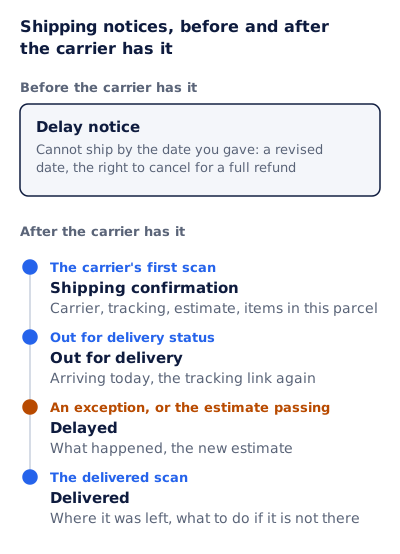
| Notice | Fired by | What it says |
|---|---|---|
| Delay notice | Before the carrier has it: you cannot ship by the date you gave | A revised date, the right to cancel for a full refund, how to cancel |
| Shipping confirmation | The carrier’s first scan | Carrier, tracking, estimate, items in this parcel |
| Out for delivery | The carrier’s out for delivery status | Arriving today, the tracking link again |
| Delayed | An exception, or the estimate passing | What happened, the new estimate |
| Delivered | The delivered scan | Where it was left, what to do if it is not there |
Out for delivery is the one to drop if you want fewer emails. Delayed is the one to keep. A customer who finds out from the tracking page that the parcel is stuck has learned that your emails stop when the news is bad. Give “where it was left” only when the carrier reports it, and give “what to do if it is not there” every time, with a real contact.
A shipping confirmation email template
Subject: Order [number] has shipped
Preheader: Arriving [estimate range]. Track it with [carrier].

Hi [first name],

Your order is on its way with [carrier].

[Button: Track your parcel]
Tracking number: [number]

Arriving: [day date] to [day date]
Going to: [name, address]

In this parcel:
[Item]  [variant]  x[qty]
[Item]  [variant]  x[qty]
[If split: Parcel 1 of 2. [Item] follows separately.]

Something wrong? Reply to this email or contact [support link].
Returns: [policy link]
The preheader carries the estimate, so a reader who never opens the email still knows when to expect it; the email preheader guide shows how to set one. Send it from the same domain as your other mail, authenticated with SPF, DKIM and DMARC: a shipping notice in the spam folder generates the “where is my order” ticket it was meant to prevent.
What does the FTC require when an order ships late?
The rule is about shipping, not delivery, and it starts before the shipping confirmation email exists. If you state a shipping time, you must have “a reasonable basis” to expect to meet it; if you state none, the FTC’s guide says you must have a reasonable basis for believing “that you can ship within 30 days”. When you cannot ship in that time, 16 CFR 435.2(b) requires you to offer the buyer, without being asked, “an option either to consent to a delay in shipping or to cancel the buyer’s order and receive a prompt refund”, and to do it no later than the original shipping time.
Email is fine for it. The FTC’s guide answers the question “Can we send the delay option notice to the customer’s e-mail address?” with “Yes.” The notice needs a definite revised shipping date, or a statement that you cannot give one, and a way to cancel at your expense. If the new date is 30 days or less after the old one, the notice must also say that silence counts as agreeing to the delay:
Subject: Order [number] will ship later than we said
Preheader: New ship date [date]. You can cancel for a full refund.

Hi [first name],

We cannot ship order [number] by [original date], as we told you.
[One line on why, if you know.]

New ship date: [date]

If you would rather not wait, you can cancel for a full, prompt refund:
[Button: Cancel my order]  or reply "cancel" to this email.

If we do not hear from you before [new date], we will take that as
agreement to the delay and ship by [new date].
A delay of more than 30 days, or one you cannot put a date on, works the other way round: the order is treated as cancelled unless the buyer agrees to the delay or you ship within 30 days of the original time. For most payment methods the FTC’s guide puts a prompt refund at “seven working days after the order is cancelled”.
The rule’s delay option is about shipping. A parcel that runs late after the carrier has it gets the plain “Delayed” notice from the table above.
Can a shipping notification email include promotions?
It can, and in the UK that turns it into a marketing email.
In the US, 16 CFR 316.3 lists content “to facilitate, complete, or confirm a commercial transaction that the recipient has previously agreed to enter into with the sender” as transactional. When a promotion sits beside it, 316.3(a)(2) makes the email commercial if a reader of the subject line “would likely conclude that the message contains the commercial advertisement or promotion of a commercial product or service”, or if the shipping content does not appear “in whole or in substantial part, at the beginning of the body of the message”. There is no percentage in the rule: placement and the subject line decide. A commercial email needs everything CAN-SPAM asks of marketing, including an opt-out honored “within 10 business days”.
In the UK, the ICO calls these “service messages”, messages “that aren’t promotional but are for administrative or customer services purposes”. It adds: “If your service message has elements that are direct marketing, even if that is not the main purpose of your message, then it will count as direct marketing.” General branding or logos do not count.
| What the shipping email carries | US (CAN-SPAM) | UK (ICO) |
|---|---|---|
| Tracking, estimate, items, your logo | Transactional | Service message |
| The same, with a product row below and a neutral subject | Transactional, under 316.3(a)(2) | Direct marketing |
| “15% off your next order” in the subject, tracking below | Commercial | Direct marketing |
Selling has its own flows, with their own consent: abandoned cart emails before the purchase, and the post-purchase stage of lifecycle email marketing after it. Keep the shipping notices about the parcel.
Does a countdown belong in a shipping email?
Almost never. A delivery estimate is a range the carrier can miss, so a clock counting to it states a precision nobody has, and a transactional email is the wrong place for pressure.
The exception is a deadline that is real and that you enforce: an order held for store pickup until a set day, after which it is returned to stock. That deadline is order information, like the estimate, and it differs per customer. In EmailTimer.app it is a per-recipient deadline in a signed address, minted from the API or from a recipient list on the Growth and Agency plans, listed on the pricing page. If the hold is not enforced, write the date in words and leave the image out.
Questions and answers
What is the difference between a shipping confirmation and a shipping notification email?
The shipping confirmation is the first notice, sent when the carrier takes the parcel. “Shipping notification” also covers the ones after it: out for delivery, delayed and delivered.
When should a shipping confirmation email be sent?
When the carrier has the parcel. Under the FTC rule, that is when it has shipped; a printed label is not.
Does a shipping confirmation email need an unsubscribe link?
A purely transactional one does not under CAN-SPAM, and it is a service message for the ICO. Add a promotion and it may become commercial in the US and is direct marketing in the UK.
What if an order cannot ship on time?
In the US, before the promised shipping time passes, offer the customer the choice to accept a revised date or cancel for a prompt refund. The FTC’s guide confirms email is an acceptable way to send that notice.
Should one order with two parcels get two emails?
Yes. Each email lists the items in its own parcel and says what is still to come, so the first delivery does not look like a short shipment.
Sources
- 16 CFR 435.1 and 435.2, Mail, Internet, or Telephone Order Merchandise Rule (Electronic Code of Federal Regulations), read on 3 November 2026
- Business Guide to the FTC's Mail, Internet, or Telephone Order Merchandise Rule (Federal Trade Commission), read on 3 November 2026
- 16 CFR 316.3, Primary purpose (Electronic Code of Federal Regulations), read on 3 November 2026
- CAN-SPAM Act: A Compliance Guide for Business (Federal Trade Commission), read on 3 November 2026
- Identify direct marketing (Information Commissioner's Office, UK), read on 3 November 2026
- Photo by Tima Miroshnichenko on Pexels
- Photo by RDNE Stock project on Pexels
Related
Put a countdown in the campaign you are writing now
The free plan covers 5,000 opens a month with no card. Starter is $19 a month for 250,000.