A Zembula alternative without a one billion email floor
By Danish Mohammed, founder. 6 min read
Zembula does something almost nobody at the enterprise end of this market does. It publishes its price. The pricing page lists Zembula Dimensions at “$0.07 per 1,000 emails sent annually (paid annually)”, and next to it a minimum volume: “Sending 1+ billion emails annually”.
That is a useful page, because it answers the buying question in one line. At the published rate a billion emails a year comes to about $70,000, so the entry price is a five-figure annual commitment before anyone talks to you. If you are not an enterprise retailer sending daily, Zembula has told you politely that you are not the customer.
Zembula pricing and limits, checked on 17 September 2026
| Zembula | EmailTimer.App | |
|---|---|---|
| Published price | Dimensions at “$0.07 per 1,000 emails sent annually (paid annually)” | Free $0, Starter $19 or Rs 1,599, Growth $49, Agency $149, per month |
| Minimum volume | “Sending 1+ billion emails annually” | None. The free plan is 5,000 image opens a month |
| Implied annual floor | About $70,000 at the published rate and the published minimum, by arithmetic | $0, or $228 a year on Starter |
| Second tier | “Custom Packages”, priced on consultation | Agency $149 a month for 5,000,000 opens |
| Billing | Annual, paid annually | Monthly or annual, in dollars or rupees |
| Free plan or trial | Neither is published | Free plan, no card, 5,000 opens a month, no watermark |
| Countdown timers | One of nine Email Modules, next to product recommendations, hero personalization, weather, video and polls | The whole product, plus personalized images in the same render |
| Delivery model | “an image at the top and bottom of your master email template” | One image URL per recipient, which your template already has an <img> tag for |
| Guarantee | “11x minimum return on spend guaranteed”, conditioned on brands sending over 1 billion emails a year at one send per address per day, measured by a 50/50 A/B test | No performance guarantee. I do not have the data to make one honestly |
| Support | Enterprise account team, not described on the pricing page | One person, who wrote the renderer, replying within one business day |
What Zembula does well
The Composition Engine is a genuinely different idea from a timer tool. Zembula describes it as a way to “Deliver any of the messages from your pool through a single image URL and link embedded within email, SMS, mobile, or on your website”. So a retailer with a daily send can vary the hero, the recommendations and the clock without rebuilding the template every morning. For a merchandising team publishing seven emails a week, that is the actual bottleneck.
Publishing the rate and the minimum is worth saying out loud. Movable Ink shows no price anywhere and routes every path to a demo request. Zembula lets a marketing manager work out in thirty seconds whether to book the call. That saves both sides a month.
The delivery shape is the easiest in the enterprise tier to adopt. The home page puts it as “dropping an image at the top and bottom of your master email template”, after which the template is not touched again.
Where it falls short
The floor is the whole story for most readers of this page. One billion emails a year is roughly 2.7 million sends a day, every day. A list of 500,000 people mailed three times a week sends about 78 million a year, which is under a tenth of the stated minimum.
Any lower entry figure you find on a software directory does not come from this page. The page publishes one rate and one minimum, and nothing else.
The guarantee has conditions attached that narrow it further. It applies to brands sending over a billion emails a year “with a frequency of 1 send per day, per email address”. It is measured by a 50/50 longitudinal A/B test run for four weeks, with every recommended use case switched on. That is a fair way to measure a claim. It is also a description of a customer profile that almost nobody reading a page about countdown timers matches.
Company scale is worth checking in procurement when the contract is annual and five figures. The pricing page carries no headcount, no funding history and no uptime commitment, so ask for those in the call rather than reading them off a directory.
What EmailTimer.App does differently
There is no minimum. The free plan is 5,000 image opens a month with no watermark, and the paid ladder starts at $19 a month for 250,000. A sender who does 78 million emails a year is a large customer here rather than an unqualified lead.
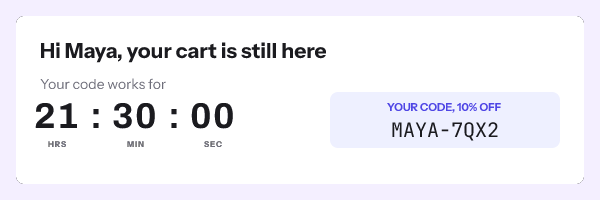
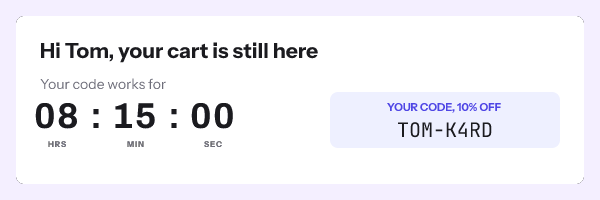
The countdown and the personalized layers come out of one render engine. A deadline, the subscriber’s first name and a voucher code arrive as one image URL, which is the same delivery model Zembula uses at the top of a master template. The difference is the price of entry and the size of the surrounding platform.
There is no sales call and no annual commitment. Prices are published in dollars and rupees on the pricing page, billing is monthly if you want it monthly, and nothing is negotiated.
What I will not claim is a return multiple. I have no customer revenue data, so a number like 11x would be invented. The features page describes what the renderer does and the about page says what the product does not have.
When Zembula is the better choice
Buy Zembula if you are an enterprise retailer sending over a billion emails a year and you want the whole personalized composition, not only the clock. At that volume the per-thousand rate is competitive and the operational saving on a daily send is the point.
Buy Zembula if the countdown is one of six things you need in the same image, and the other five include product recommendations driven by your catalogue. Nothing here recommends products.
Buy Zembula over Movable Ink if the published rate beats the contract you were quoted. Public contract data puts Movable Ink well into six figures a year, which is covered on the Movable Ink page.
If you are below the stated minimum, the choice is not between Zembula and something cheaper. Zembula has already excluded you, and the real comparison set is the roundup.
How to move
Coming off an enterprise composition platform is a bigger job than swapping a timer vendor, because the platform was doing more than the timer.
- List every dynamic region the Zembula image was composing: the countdown, the hero, any recommendations, weather or poll. Separate the ones you use from the ones that came in the bundle.
- Take the countdown and any merge-value layers first. Those are what one render engine here replaces, in one image, on one plan.
- Decide where recommendations go. If your catalogue feed drove them, that job moves to your ESP’s own recommendation block or stays out of the email.
- Rebuild the timer at the same pixel width as the composed region, or at the width of the slot it will occupy once the composition is gone.
- Replace the
srcinside the existing<img>. Keep the width attribute and the alt text. - For per-recipient deadlines, pass the identifier your platform already has. The per-platform merge tag is on each integration page.
- Keep the old contract running until the last scheduled send that embeds its URLs has gone out.
Questions and answers
How much does Zembula cost?
Its pricing page lists Dimensions at “$0.07 per 1,000 emails sent annually (paid annually)” with a minimum volume of “Sending 1+ billion emails annually”. Multiplying the rate by the minimum gives roughly $70,000 a year as the entry commitment. Custom packages are priced on consultation.
Does Zembula do countdown timers?
Yes. Countdown Timers is one of nine Email Modules on the site, next to product recommendations, hero personalization, weather, video and polls. The timer is one component of a larger personalization product.
Is there a Zembula free trial?
None is published on the pricing page. The free plan here needs no card and no call, at 5,000 image opens a month.
I send 50 million emails a year. Can I use Zembula?
That is under 5 percent of the stated minimum, so the published plan does not apply to you. A custom package is the only route offered, and at that point the price is whatever the conversation produces.
What do I lose by moving to a timer tool?
The composition. A timer tool draws a deadline and your merge values into a picture. It does not choose which products to show. If recommendations were the reason for the contract, keep them and move only the clock.
Next: the Movable Ink alternative for the other enterprise route, the NiftyImages alternative for the mid-market one, and the roundup for everything in one table.
Prices checked on 17 September 2026. Vendors change their prices without announcing it, so check the figure you care about before you act on it.
Sources
- Zembula pricing, read on 17 September 2026
- Zembula home page, read on 17 September 2026
Related
Put a countdown in the campaign you are writing now
The free plan covers 5,000 opens a month with no card. Starter is $19 a month for 250,000.