A NiftyImages alternative with a free tier
By Danish Mohammed, founder. , updated 12 min read
NiftyImages is the closest match to what EmailTimer.App does, because it is the other tool that puts countdown timers and personalized images on one subscription. It republished its pricing between 16 and 23 September 2026, and the shape changed as well as the numbers. Volume and features are now two separate choices rather than one ladder, the cheapest tier that carries countdown timers is $59 a month for 25,000 opens, and the developer API has moved to an Enterprise tier that publishes no price at all.
NiftyImages pricing, checked on 23 September 2026
Read off the NiftyImages pricing page on 23 September 2026. The page puts three tiers against a slider of opens a month. Starter, Growth and Scale all come in the same five sizes, so you pick the feature set on one axis and the volume on the other.
| Opens a month | Starter | Growth | Scale | Starter per 1,000 |
|---|---|---|---|---|
| 25,000 | $59 | $149 | $239 | $2.36 |
| 50,000 | $89 | $179 | $269 | $1.78 |
| 100,000 | $149 | $239 | $329 | $1.49 |
| 250,000 | $299 | $389 | $479 | $1.20 |
| 500,000 | $549 | $639 | $729 | $1.10 |
| Above 500,000 | Custom | Custom | Custom | Not published |
Monthly billing. The page’s own unit is “opens a month”. Switching it to annual multiplies the allowance by twelve and discounts the total under a “Save 20%” label: Starter at 25,000 opens a month is $564 a year against $708 paid monthly, a saving the page itself puts at $144. Above 500,000 opens every tier reads “Custom” and the buttons change to asking for a quote.
Above Scale sits Enterprise, at “Custom Pricing” and “Billed Annually”, with no number anywhere on the page. What it adds over Scale is geo-targeted maps, external web APIs, full data stores, a developer API and store MCP, custom image URLs, agency features and logins, a dedicated account representative, and onboarding and strategy calls.
Which tier carries what, in the page’s own words. Starter has personalized images, countdown timers, weather on your images, and custom fonts and click tracking. Growth adds polls, scratchers, social signals, slides, charts and calendars. Scale adds rule sets, A/B split tests, critical messages, and two data stores of up to 10,000 rows each.
On the free trial the page says: “Try Starter through Scale with free images. No time limit or credit card required.” It does not say how many opens the free images cover, or how many images, so that is a number this page cannot give you. There is no free plan in the tier list.
For the record, because the previous version of this page is what the change is measured against: reading the same page on 16 September 2026 recorded a Starter tier at $25 a month for 50,000 opens, a Pro tier at $100, a Scale tier at $450 covering 12,000,000 opens a year, and a Business tier from $1,250 a month carrying API access. None of those tiers is on the page today, and Pro and Business no longer exist as names. The arithmetic per open at every published volume, and where the $450 and $950 figures still circulating come from, is in what dynamic images cost per open.
How the two compare
| NiftyImages | EmailTimer.App | |
|---|---|---|
| Free tier | No free plan in the tier list. A trial instead, “with free images. No time limit or credit card required”, with the allowance not stated | $0 for 5,000 image opens a month, no card |
| Entry plan carrying countdown timers | Starter, $59 a month for 25,000 opens a month, or $564 a year | Starter, $19 a month for 250,000 opens a month, or $190 a year |
| Cost per 1,000 opens at that entry plan | $2.36 | $0.076 |
| The same 250,000 opens a month | Starter, $299 a month | Starter, $19 a month |
| What the free tier withholds | Not applicable. There is no free plan to withhold anything | Brand font uploads, the flip, ring and progress-bar styles, conditional layers, more than 3 live images at once |
| Watermark or branding | No watermark on paid plans | No watermark on the free plan inside its allowance. Past 110 percent of any plan’s allowance, new renders carry a small watermark until you move up |
| Evergreen per-recipient timers | “Countdown Timers” are listed on Starter and above. The pricing page does not itemise timing models, so confirm evergreen behaviour before you buy | Six timing models on every plan, including evergreen from first open and evergreen from send |
| Personalized images | Yes, this is the core product, on Starter and above. Polls, charts, slides and calendars are Growth. Rule sets, A/B split tests and two data stores are Scale. Full data stores, external web APIs and geo-targeted maps are Enterprise | Yes, from the same engine as the timers, on every plan, in the same image if you want both |
| API | “Developer API & Store MCP” is an Enterprise feature, and Enterprise is a custom annual quote with no published number | REST API from Growth, $49 |
| Custom fonts | “Custom fonts & click tracking” on Starter and above | Your own .woff2 or .ttf from Starter, $19 |
| Longest countdown | Not published | 9,999 days on the largest unit, about 27 years, then the value holds at all nines |
| Support | Not itemised by contact method for Starter, Growth or Scale. Enterprise lists a dedicated account representative | One person, who wrote the code, replying within one business day |
NiftyImages figures read on 23 September 2026. The range here, in dollars and rupees, is on the pricing page.
What NiftyImages does well
It has been doing this the longest, and it shows in the depth of the data work. Rule sets, A/B split tests and data stores on Scale, and external web APIs and full data stores on Enterprise, cover cases a timer tool never reaches. If your images need to read from a feed and change with it, that is real engineering you would otherwise build yourself.
The new pricing structure is better designed than the one it replaced. Volume and capability are priced on separate axes, so a team that wants 500,000 opens a month and nothing beyond personalized images and timers can buy Starter at $549 rather than being pushed up a combined ladder into features it will not use. The version of this page written a week ago criticised the old ladder for exactly that, and the criticism no longer applies.
The trial terms are now stated, and they are generous: no time limit and no credit card, across Starter, Growth and Scale. A buyer can evaluate it for as long as the evaluation takes. What the page does not state is how much rendering the trial allows, which is the number you would want before planning a real test campaign.
It is also the most actively shipped competitor in the category. The developer surface is the best here by a distance: developer documentation, an MCP server and published agent skills. Nothing else in this market ships an MCP server, this product included.
The Photoshop workflow is well known because NiftyImages made it well known. Its Photoshop timers page is the page most designers have seen on the subject, and a studio that already lives in PSD files will recognise the flow immediately.
Custom fonts and countdown timers are both on the entry Starter tier rather than held back for an upsell, which is more generous than most of the cheap timer tools manage.
Where it falls short
The developer API has no published price. It moved from a Business tier that at least printed a floor of $1,250 a month to an Enterprise tier that prints nothing, so a developer who wants to mint a personalized image from a job queue now has to open a sales conversation to find out what that costs. The MCP server and the agent tooling sit behind the same quote.
The price moved a long way inside a week, and nothing on the page says so. Between the two readings above, the entry price went from $25 for 50,000 opens a month to $59 for 25,000, and the tier names changed. There is no changelog and no effective date on the pricing page. If you are building a budget line against it, read the page on the day and keep a copy.
Its own customers are annoyed about billing and communication. On Capterra, NiftyImages holds 3.7 out of 5 from 6 reviews. A two-star review titled “Bad communication with clients” says “Client communication was really bad, and charges were applied without notification”. Another, titled “Okay product - customer service is lacking”, says “Lack of trasnaprency and communication”. Six reviews is a small sample, and it is the sample that exists.
The Photoshop documentation has aged. The concept page is supported by a blog post dated 27 July 2018, revised once in November 2019, and Photoshop has shipped years of releases since.
What EmailTimer.App does differently
The starter tier is ten times the volume for $40 less a month. $19 for 250,000 opens a month against $59 for 25,000 works out at $0.076 a thousand against $2.36 a thousand. Buying the same 250,000 opens a month from NiftyImages means its $299 Starter plan, which is $280 a month more, or $3,360 over a year. That gap holds at every stop on the published slider, and it is the plainest reason to look here.
The free plan is permanent and carries no watermark. 5,000 opens a month, no card, three live images. It is deliberately small, and it is enough to put a real timer in a real campaign and see what your own inboxes do with it before anybody signs a purchase order. It is also a published number, which the NiftyImages trial allowance is not.
The API is on the $49 plan, and its price is on the page. REST endpoints, CSV recipient uploads and webhooks are included from Growth. For anyone with a developer in the building, that is the largest gap between the two products, because the comparable surface at NiftyImages is an Enterprise quote.
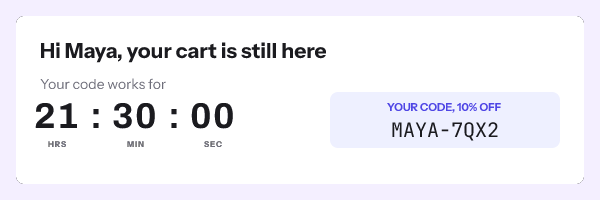
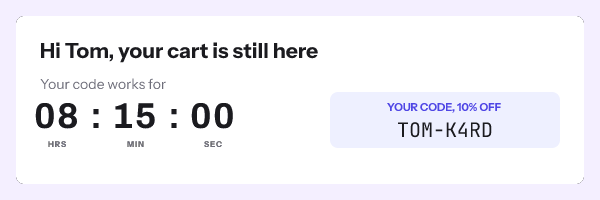
The countdown and the personalized layers are the same render. One URL produces one image with the hours left, the first name and a unique voucher code baked into the pixels. A cart-abandonment email has one asset to approve rather than two to keep in sync. What that looks like is on the features page.
The Photoshop import is documented this decade. Open the supplied template, drop your artwork behind the safe area, name the layers, upload. The rules, the refusals and the one thing you cannot change afterwards are in the PSD timer guide.
Client behaviour is published before the sale. Apple Mail pre-fetches at delivery, and testing reports it holds images two to three days, so an evergreen timer anchors at delivery for those recipients. Gmail’s proxy caches per recipient per URL, and Google publishes no lifetime for it. Outlook on Windows renders frame one only. The editor previews each case. This is a documented table rather than a photographed inbox test, and the page says that too.
Support is one person on a one business day clock, and that person wrote the renderer. There is no account manager and no escalation path, which is a real cost and worth knowing before you buy. NiftyImages puts a dedicated account representative on its Enterprise tier, and if that is what you need, that is where it is.
When NiftyImages is the better choice
Stay with NiftyImages if your team already has it and your images depend on its data features. Rule sets and data stores on Scale, and external web APIs and geo-targeted maps on Enterprise, are not matched here, and migrating a working feed-driven programme to save money is a bad trade.
Choose NiftyImages if A/B split tests inside the image tool are a requirement. They are on Scale, which starts at $239 a month for 25,000 opens a month, and there is nothing equivalent here at any price.
Choose NiftyImages if polls, scratchers, social signals, slides, charts or calendars inside an email image are on your list. Those are Growth features, from $149 a month at 25,000 opens a month, and none of them exists here.
Choose NiftyImages if you need its developer API and MCP surface and your organisation is comfortable buying an Enterprise contract without a published price. Its developer documentation and agent tooling are ahead of anything here today, and at enterprise volumes the per-open arithmetic matters less than what the tooling lets your team build.
Choose NiftyImages if your design team’s entire workflow is Photoshop files handed over by an agency, and the people doing it already know the NiftyImages flow by heart. The import here handles PSDs, and theirs has a decade of institutional memory behind it.
How to move
- Inventory what you actually use. Separate plain timers and merge-tag images, which move over in an afternoon, from anything driven by a rule set, a chart, a poll or a data store, which does not.
- Record each image’s pixel width and its deadline in UTC. Width first: a wider image reflows an Outlook layout that was fine yesterday.
- Rebuild one template here and match the width. If a brand font was doing the work, upload the .woff2 or .ttf on Starter and compare the two renders side by side at 100 percent zoom.
- Swap the
srcvalue inside the existing<img>tag. Keep the width attribute, the alt text and the link wrapper. Nothing else in the HTML changes. - Map the merge tags. Each integration page carries the exact tag syntax for that platform, and the timing model you want is set out in the timer types guide.
- Run one campaign on both tools in the same week, on the same segment, and compare the images that came back. That is the only test that settles it.
- Keep the NiftyImages account open until every delivered campaign that embeds its images has stopped being read. A cancelled account turns those into broken images, and a delivered email cannot be edited.
Questions and answers
How much does NiftyImages cost?
Read on 23 September 2026, its pricing page prices three tiers against a slider of opens a month. Starter runs $59 at 25,000 opens a month to $549 at 500,000. Growth runs $149 to $639. Scale runs $239 to $729. Above 500,000 opens every tier is a quote, and the Enterprise tier is a custom annual quote with no number on the page. Annual billing is discounted 20 percent.
Does NiftyImages have a free plan?
No. Its pricing page lists Starter, Growth, Scale and Enterprise, none of them free. It offers a trial instead, described as “Try Starter through Scale with free images. No time limit or credit card required.” The page does not say how many opens or images the trial covers. Checked on 23 September 2026.
How much is the NiftyImages API?
Not published. “Developer API & Store MCP” is listed as an Enterprise feature, and Enterprise shows “Custom Pricing” and “Billed Annually” with no figure. Checked on 23 September 2026. The API here is included on the $49 Growth plan.
Is EmailTimer.App a full replacement for NiftyImages?
For timers, merge-tag images, QR codes, progress bars and Photoshop imports, yes. For rule sets, charts, polls, scratchers, live data stores and A/B split tests, no, and those are the reasons to stay.
What does the price difference actually come to?
At the entry plan, $19 for 250,000 opens a month here against $59 for 25,000 there, which is $0.076 a thousand against $2.36 a thousand. Matched on volume instead, 250,000 opens a month is $19 here and $299 on the NiftyImages Starter tier, a difference of $3,360 a year. Prices read on 23 September 2026.
Can I run both while I migrate?
Yes. Both products are image URLs inside an <img> tag, so one template can point here and another can keep pointing at NiftyImages with no conflict.
Next: what dynamic images cost per open for the per-open arithmetic across the category, the Movable Ink alternative if the shortlist has crept into enterprise territory, or the Litmus Personalize alternative if a timer is being bundled with a QA suite. The older head-to-head is at EmailTimer.App vs NiftyImages.
Prices checked on 23 September 2026. Vendors change their prices without announcing it, so check the figure you care about before you act on it.
Sources
- NiftyImages pricing, read on 23 September 2026
- NiftyImages homepage, read on 23 September 2026
- NiftyImages Photoshop timers, read on 23 September 2026
- NiftyImages blog: creating Photoshop timers (27 July 2018), read on 23 September 2026
- NiftyImages reviews on Capterra
Related
Put a countdown in the campaign you are writing now
The free plan covers 5,000 opens a month with no card. Starter is $19 a month for 250,000.