A Movable Ink alternative for timers and images
By Danish Mohammed, founder. 8 min read
Movable Ink is an enterprise personalization platform whose countdown timers are one small part of a very large product. It publishes no prices anywhere, and public contract data puts the median deal at $185,355 a year. That is the right number for a brand running one-to-one creative across every channel, and the wrong number for a team that wants a clock and a first name in an image.
Movable Ink pricing and limits, checked on 16 September 2026
Checked on 16 September 2026, which is the day it was confirmed that there is nothing to check. Movable Ink has no pricing page: movableink.com/pricing returns a 404, and every call to action on the platform page is a route to a demo. The contract figures come from Vendr.
| Movable Ink | EmailTimer.App | |
|---|---|---|
| Free tier | None. No self-serve sign-up of any kind | $0 for 5,000 image opens a month, no card |
| Entry paid plan | Not published. Vendr reports a median contract of $185,355 a year, ranging from $89,230 to $312,537 | Starter $19 for 250,000 opens, paid by card, no call |
| What the free tier withholds | Not applicable. There is no free tier and no trial | Brand font uploads, the flip, ring and progress-bar styles, conditional layers, more than 3 live images at once |
| Watermark or branding | No watermark | No watermark on the free plan inside its allowance. Past 110 percent of any plan’s allowance, new renders carry a small watermark until you move up |
| Evergreen per-recipient timers | Per-recipient content is the core of the product. Specifics are not published | Six timing models on every plan, including evergreen from first open and evergreen from send |
| Personalized images | Yes, at a depth nothing else here matches. Studio for one-to-one creative, Da Vinci for AI content decisioning, and Programmatic CRM flagged for a 2026 launch | Yes, from the same engine as the timers, in the same image as the countdown if you want both |
| API | Not published | Included from Growth, $49 |
| Custom fonts | Not published | Your own .woff2 or .ttf from Starter, $19 |
| Longest countdown | Not published | 9,999 days on the largest unit, about 27 years, then the value holds at all nines |
| Support | Account team and professional services, priced separately | One person, who wrote the code, replying within one business day |
The full range here, in dollars and rupees, is on the pricing page. Movable Ink’s is a sales conversation.
What Movable Ink does well
The depth of personalization is the real thing, and the countdown is incidental to it. The platform page shows offer creative assembled per recipient. The two named products behind it are Studio, for one-to-one content, and Da Vinci, for AI decisioning in batch programmes. Both are aimed at deciding what each person should see rather than at drawing a clock.
It runs across channels. A large retailer sending email, mobile and web from one set of creative rules gets something from that which a timer service cannot provide at any price.
It comes with people. Implementation, template building, data integration and ongoing optimisation are delivered as services alongside the platform. For a team of two marketers running a national brand, buying hands is often the point.
The brand and the customer list are the safest choice in the category. Nobody gets fired for shortlisting Movable Ink.
Where it falls short
There is no way to try it. No free tier, no trial, no month-to-month. A write-up by a competing vendor, Driphue, says there is “no self-serve or month-to-month option” and that “every engagement starts with a sales conversation and a scoped proposal”. It is a competitor’s page, and it matches what Movable Ink’s own site does, which is offer a demo on every route.
The services bill sits on top of the platform bill. The same write-up notes that “Movable Ink implementations frequently require professional services for initial setup, template creation, data integration, and ongoing optimisation”, and that those costs are “separate from and additive to the platform fee, and can be substantial”.
The commitment is annual and the exit is expensive. Driphue reports that most contracts include minimum volume or spend commitments and that “Exiting before the term ends is typically costly.” Vendr’s range, $89,230 to $312,537 a year, is the shape of that commitment. The two sources disagree about the floor. Driphue puts a baseline implementation at $30,000 to $60,000 a year, well below Vendr’s low end. Read Vendr’s low figure as the cheapest deal it has records of, not the cheapest deal available.
Changes are slow, and competitors attack exactly this. Zembula, which sells against Movable Ink, argues that the image-app model Movable Ink uses produces images that are “inflexible and hard to change once they have been produced”, and that “each image can only contain one data source and the design and development takes quite a bit of time”. Treat that as a rival’s framing, then ask your own account team how long a copy change takes to go live. That answer decides whether you can run a same-day promotion.
The public review record is thin. Movable Ink has zero reviews on Capterra and zero on GetApp, both checked on 16 September 2026. For a platform at this price that is a strange absence, and it means reference calls are your only diligence route.
What EmailTimer.App does differently
You can be sending in an afternoon, for nothing. Sign up, publish a timer, paste the image URL. No demo, no scoping call, no statement of work. The free plan is 5,000 opens a month with no watermark and no card.
The price is published and the unit is simple. $19 for 250,000 opens works out at $0.076 a thousand. The whole ladder, in dollars and rupees, is on the pricing page, and annual billing is ten months rather than twelve.
A change takes minutes and you can see it before it ships. Edit the template, publish a new version, and the preview is rendered by the same engine that serves the inbox. Published versions keep rendering, so a new version never breaks a campaign already sent against the old one.
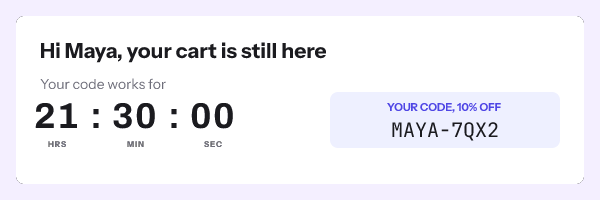
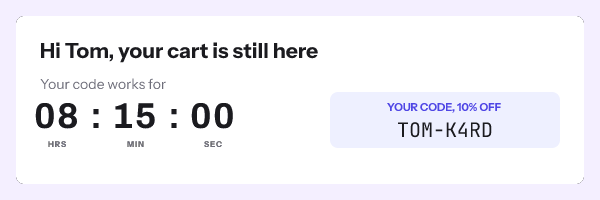
The countdown and the personalized layers are one image. Hours left, first name and a unique voucher code in a single PNG or GIF, which is where the two products overlap and the only place they do. What that covers is on the features page.
The API is $49 a month, not a scoping exercise. REST endpoints, CSV recipient uploads and webhooks are on Growth.
What is absent, in a list, because it decides purchases. There is no cross-channel decisioning, no AI content selection, no services team, no account manager, no master services agreement and no signed uptime credit. One person writes the code and answers the mail, within one business day. If your compliance process needs a vendor questionnaire and a negotiated contract, it needs a bigger company than this one today.
When Movable Ink is the better choice
Buy Movable Ink if you need one-to-one creative across email, mobile and web, decided per recipient from live data. That is the product, and no timer service substitutes for it.
Buy Movable Ink if you have a services budget and need the work done rather than the tool supplied. Implementation and ongoing optimisation delivered by their team is a genuine reason to pay the difference.
Buy Movable Ink if procurement requires an enterprise vendor: a master agreement, security review, contractual uptime, named support. None of those exist here yet.
Buy Movable Ink if a countdown is a footnote in a programme where AI content decisioning is the main event. Nothing on this page argues otherwise.
The case for moving is narrow and specific. You are paying six figures for a platform of a dozen or more named products, and using two of them: the countdown timer and a personalized image.
How to move
Do not migrate a Movable Ink programme. Carve out the piece that is a timer and prove it beside what you already have.
- Audit which modules you actually use, by module, over the last two quarters. If the answer includes cross-channel decisioning or Da Vinci, stop here.
- Pick one campaign whose personalization is a countdown, a name and a code. A flash sale or a cart-abandonment flow is the usual candidate.
- Rebuild that one image here. Note the pixel width first and match it, so the template does not reflow in Outlook.
- Replace the
srcvalue inside the existing<img>tag. Width, alt text and the link wrapper stay as they are. Merge tag syntax for your sending platform is on its integration page. - Run both in the same week on comparable segments and compare the delivered images, not the dashboards.
- Take the finding into the renewal conversation. Either the module count justifies the contract or it does not, and now you have the evidence either way.
- Do not switch anything off until every delivered campaign carrying Movable Ink images has stopped being read. Those URLs die with the contract, and a delivered email cannot be edited.
Questions and answers
How much does Movable Ink cost?
Nobody outside the company can tell you exactly. No Movable Ink page carries a price and movableink.com/pricing is a 404. Vendr’s records put the median at $185,355 a year, with services billed on top.
Does Movable Ink do countdown timers?
Yes, its platform page shows offer creative with a countdown among the examples. The timer is a small part of a platform built for one-to-one content decisioning.
Can EmailTimer.App replace Movable Ink?
For countdown timers and merge-tag personalized images, yes. For cross-channel decisioning, AI content selection and an implementation team, no, and those are the reasons enterprises buy it.
Why are there no reviews of Movable Ink?
Its Capterra and GetApp listings both show zero reviews, checked on 16 September 2026. The practical consequence is that reference calls are the only diligence available to you.
What is the cheapest honest comparison?
$19 a month for 250,000 opens against a median contract of $185,355 a year. Those two numbers buy very different things.
Next: the Litmus Personalize alternative for the mid-enterprise version of this question, and the NiftyImages alternative for the self-serve tool that does timers and images without a sales call.
Prices checked on 16 September 2026. Vendors change their prices without announcing it, so check the figure you care about before you act on it.
Sources
- Movable Ink platform page, read on 16 September 2026
- Movable Ink homepage, read on 16 September 2026
- Movable Ink contract data on Vendr
- Movable Ink listing on Capterra
- Movable Ink listing on GetApp
- Driphue: Movable Ink pricing and alternatives, read on 16 September 2026
- Zembula: why you should not be paying as much as you do for Movable Ink, read on 16 September 2026
Related
Put a countdown in the campaign you are writing now
The free plan covers 5,000 opens a month with no card. Starter is $19 a month for 250,000.